BendDating.com - Can a Nonprofit, Ethical and Safer Path to Love Succeed?
Is Bend’s dating nightmare ever going to end?
Traditional and Mainstream Dating Apps
Traditional and mainstream dating apps are designed to maximize engagement, rather than support relationship formation. The incentive structures of those apps drive harm. Swipe mechanics, streaks, and pay-to-be-seen boosts create addiction-like loops and “paradox of choice,” nudging users to impulsive, appearance-based judgments and endless browsing rather than moving toward commitment. Algorithmic matching optimizes for time-on-app rather than compatibility. The apps foster dependency and frustration. Their environment normalizes lame and low-empathy behaviors, ghosting, breadcrumbing, love-bombing; their weak verification of participants enables catfishing, scams, and misrepresentation. Monetization tiers introduce inequity (those who pay get visibility), pushup sales can exploit loneliness. Heavy filtering and performative profiles erode authenticity and self-esteem, and prolonged texting without offline connection leaves people in “textationships,” amplifying burnout and cynicism.
Note: For more information see: Traditional Dating Apps are Broken
What is BendDating.Com?
Bend Dating operates an online controlled-membership community in which access is conditioned on identification, disclosure, background checks, enforceable conduct standards, and acceptance of institutional accountability. Bend Dating was developed as a local, nonprofit, accountability-oriented alternative to conventional dating applications. Its seven accountability layers do not merely provide optional safety features after a person has entered the platform. They establish a controlled gate. A prospective member must accept identity-linked participation, substantive disclosure, enforceable conduct standards, screening requirements, community accountability, and the possibility of investigation, suspension, expulsion, and prevention of reentry. This design materially changes who can enter, how anonymously a person can act, and what consequences may follow misconduct.
Note: For more information see: How Bend Dating Builds Safety
Bend’s Dating Nightmare
Bend’s dating nightmare is not simply that some people have difficulty finding a compatible partner. It is the cumulative result of a dating environment that often rewards attention, novelty, concealment, and continued app use more than honesty, accountability, commitment, or successful relationships. On dating apps people may encounter false or misleading profiles, disposable accounts, ghosting, harassment, manipulation, financial exploitation, coercion, and repeated contact from individuals who face few meaningful consequences. These behaviors have consequences when acted out in face to face encounters. When harm occurs, the burden is usually placed on the individual to recognize the danger, preserve evidence, avoid or block the person, report the conduct, recover emotionally, and protect others, often without knowing whether the platform investigated, identified a pattern, or prevented the person from returning. Apps and social media allow people to report events or create stories that never happened.
The problem is intensified in a relatively small community. People may repeatedly encounter the same individuals online, through mutual acquaintances, at work, or in public places. Reputation can travel informally, but reliable information is fragmented and difficult to verify. A person removed from one platform may simply create another account or move to a different service. Someone who behaves deceptively or abusively toward one person may continue contacting others because the experiences remain isolated. Victims may hesitate to report because they fear retaliation, embarrassment, disbelief, reputational harm, or unwanted exposure within the community.
At the same time, many people using one dating app may be sincere about companionship, commitment, family, or a lasting relationship but must compete within systems designed around rapid judgments, continuous browsing, and low-cost rejection. The abundance of apparent choices can create the impression that a better option is always one swipe away. Profiles become advertisements. Human beings become interchangeable selections. Ordinary differences are treated as reasons to keep searching rather than opportunities to communicate, adapt, and develop a relationship. People can spend months or years interacting without becoming more informed, secure, or successful.
Bend’s nightmare also includes a failure of institutional responsibility. Conventional dating platforms generally provide terms of service, blocking tools, safety advice, and reporting functions, but they often disclose little about how reports are evaluated, how patterns are detected, how sanctions are imposed, or how removed users are prevented from returning. Identity verification, when offered, may confirm that a person possesses an identity document without establishing honesty, relationship readiness, character, or safety. Background checks can provide useful information but remain incomplete. Psychological or relationship information can support informed choice but cannot predict every harmful act. No single safeguard is sufficient.
The result is a fragmented system in which:
People seeking serious relationships struggle to distinguish sincerity from performance.
Predatory or exploitative individuals can move between multiple circles of friends, online accounts, platforms, and victims.
Casual misconduct and serious harm may remain disconnected rather than recognized as patterns.
Members receive limited reliable information before assuming emotional, financial, or physical risk.
Platforms in particular benefit financially from continued participation, even when repeated failure keeps people using the service.
Individuals are expected to manage risks that the institution is better positioned to identify, document, and mitigate.
People become discouraged, distrustful, isolated, or resigned to the belief that healthy relationships are no longer realistically available.
Risk-Impacting Objectives Analysis
Bend Dating just completed a Risk-Impacting Outcomes (RIO) analysis. Below is graphical representation based on empirically supported evidence and models. The model illustrates the Bend Dating Nightmare. Everything in the upper right corner is the nightmare. So it is easy to see why Bend Dating is a nightmare, not just n dating apps but also in general.
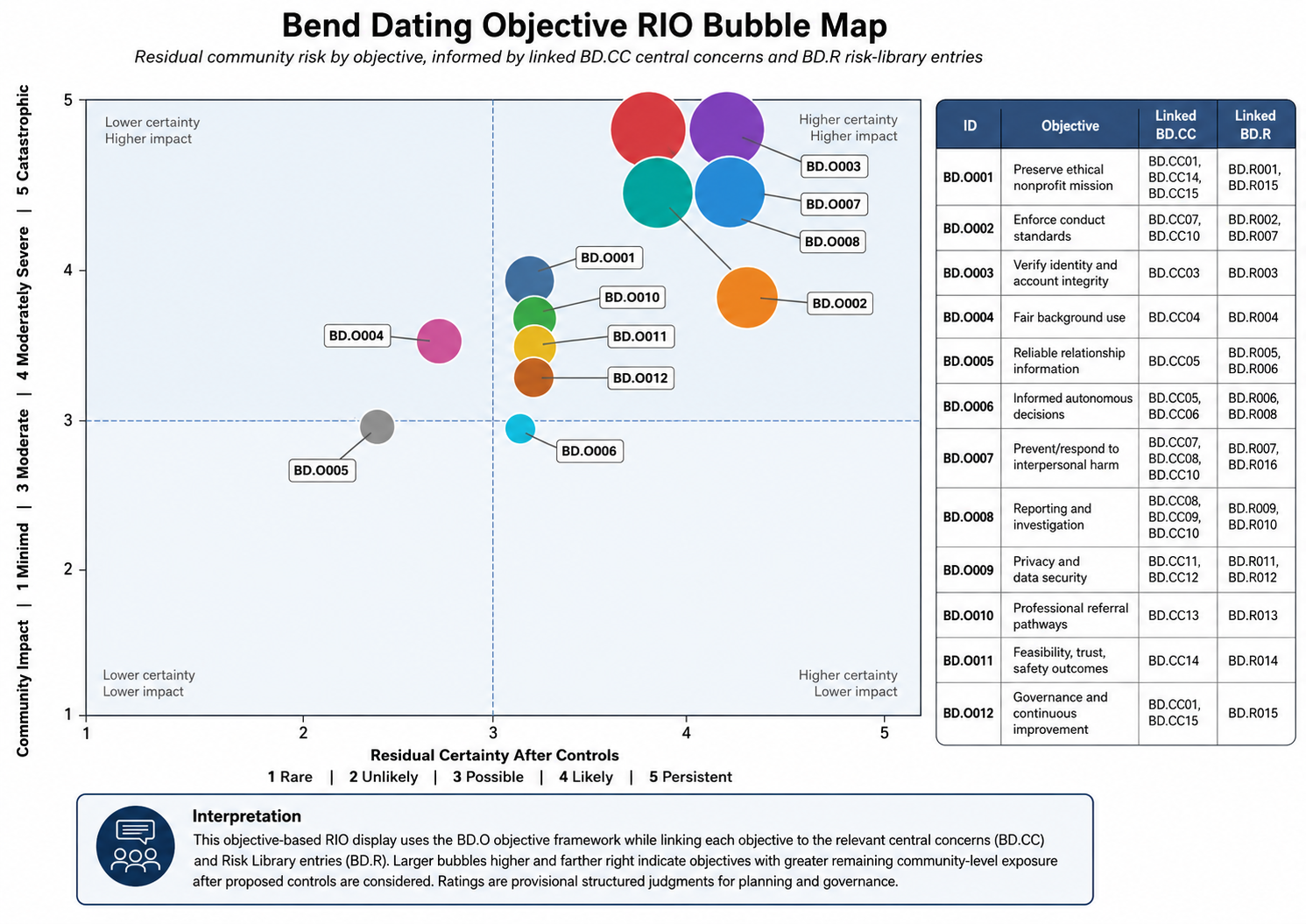
The nightmare is what Bend Dating proposes to address. The goal is not to promise that harmful, dishonest, or incompatible people can be identified with certainty. Nor is it to guarantee that every member will find love. The goal is to replace a largely anonymous and weakly accountable dating environment with a locally governed system that increases knowledge, raises the cost of deception and misconduct, supports reporting, identifies patterns, imposes meaningful consequences, and helps members make better-informed relationship decisions.
Bend’s dating nightmare may be difficult to end because the conditions sustaining it are not merely technical. They include commercial incentives, cultural habits, fear of commitment, normalization of disposable relationships, privacy concerns, distrust of institutions, resistance to accountability, and the unwillingness of some participants to accept standards that limit their freedom to deceive, exploit, or avoid consequences. Bend Dating can create a safer path, but that path will succeed only if enough members, professionals, community leaders, and governing institutions are willing to support a dating culture built around honesty, responsibility, informed choice, and mutual accountability.
Below is graphical representation based on empirically supported evidence and models. The model illustrates the impact of Bend Dating on the Nightmare. Everything in the lower left corner is the projected impact Bend’ Dating nightmare. It is not perfect. But is evidence-based and accountable because Bend Dating is committed to internationally accepted internal auditing practices.
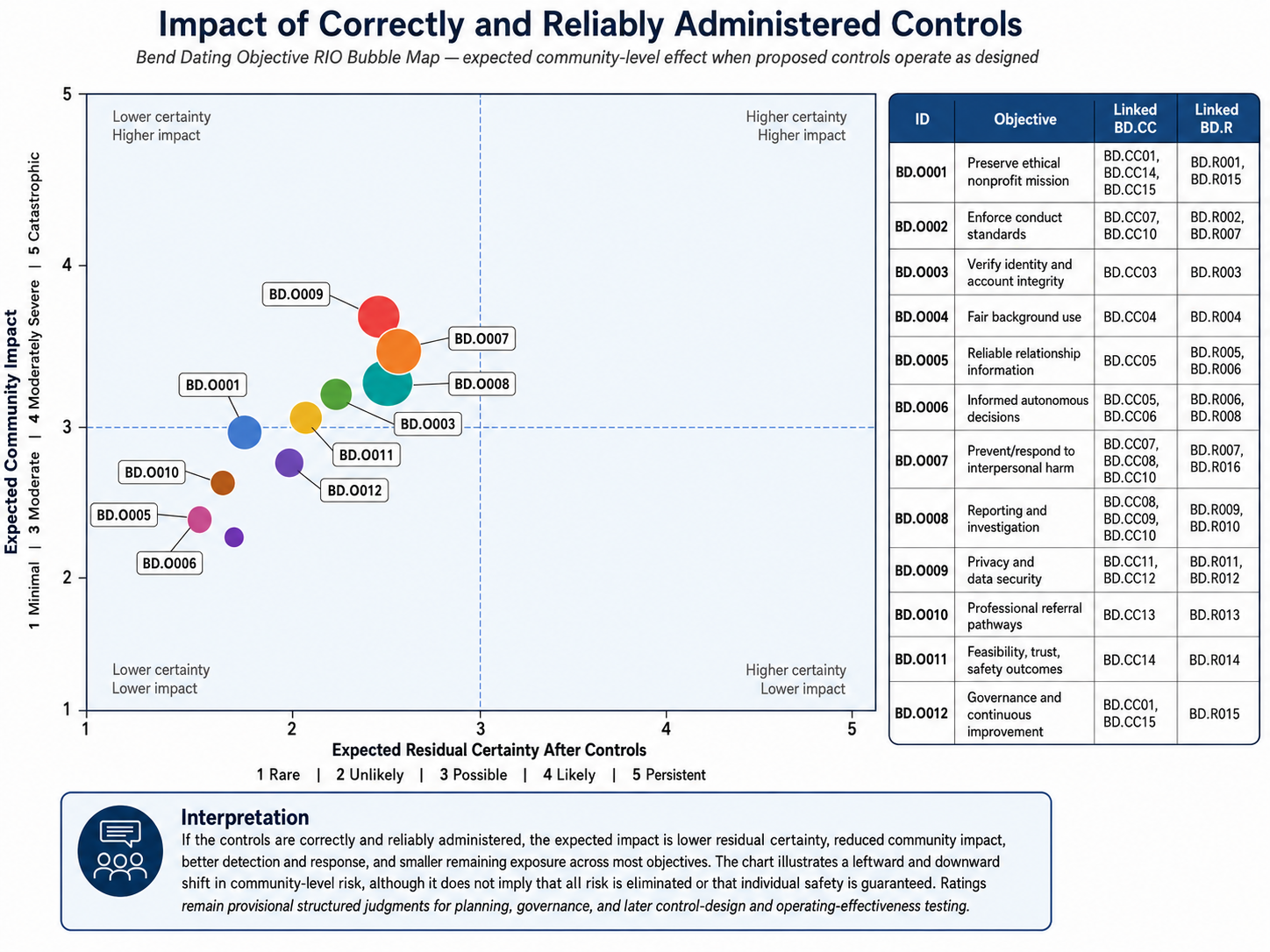
Bend Dating may not be financially successful in Bend if success is measured by conventional dating-app economics. Bend is a geographically limited market, and a dating platform requires sufficient member density across age, gender, orientation, and relationship-preference groups to produce useful matches. Bend Dating also imposes intentional entry friction, identity verification, conduct requirements, optional background screening, relationship information, reporting systems, and enforceable accountability, that may reduce enrollment compared with low-friction swipe applications. At the same time, these safeguards create continuing costs for verification, privacy, cybersecurity, trained personnel, investigation, enforcement, professional oversight, insurance, and governance. The enterprise may therefore be socially valuable and operationally sustainable without becoming conventionally profitable.
Bend Dating is also likely to encounter opposition because its mission redistributes power and responsibility. Predatory, deceptive, or exploitative individuals may object because verified identity, reporting, sanctions, and reentry prevention reduce access to vulnerable people and increase the likelihood of detection. Other objections may be ideological rather than predatory. Some people may regard an institutional emphasis on commitment, family formation, children, honesty, and relationship competence as moralizing, paternalistic, heteronormative, or inconsistent with casual, nonexclusive, or nontraditional relationship models. Others may oppose any pronatalist implication or reject the premise that declining marriage, fertility, or family formation should be treated as a social concern. It would be more accurate to describe this as opposition to pronatalist or family-formation priorities, rather than asserting that particular countries or political groups affirmatively support depopulation.
Why Bend Dating Is Worth Doing
Bend Dating is worth doing because the existing dating environment has failed too many people for too long. It has normalized deception, disposable relationships, anonymous misconduct, weak accountability, and the expectation that individuals must manage serious risks on their own. The dominant platforms profit when people remain dissatisfied, continue searching, and return to the app. Bend Dating proposes a different institutional purpose: help people obtain better information, make informed choices, form healthy relationships, and leave the platform when they succeed.
Bend Dating does not promise that every member is honest, compatible, emotionally healthy, or safe. It does something more credible. It creates enforceable standards, verifies identity, provides structured relationship information, supports background screening, educates members, establishes professional resources, enables reporting, investigates concerns, imposes consequences, prevents reentry, measures performance, and corrects failures. It accepts responsibility for the conditions it creates rather than placing the entire burden on the person who is harmed.
The enterprise may be difficult to sustain financially. Some people will resist its entry requirements. Others will reject accountability, object to scrutiny, prefer anonymity, or oppose its emphasis on commitment, family, children, and durable relationships. Predatory and exploitative people have the clearest reason to oppose it: Bend Dating makes vulnerable people harder to access, misconduct easier to report, patterns easier to detect, and removal more consequential. Those objections do not make the project less necessary. They help explain why it is necessary.
Bend Dating is worth doing because a community should not accept the dating nightmare as inevitable. Bend can test whether a nonprofit, locally governed, evidence-informed dating system can replace indifference with responsibility and replace empty safety language with controls that can be examined, measured, and improved. Even if the project is difficult, imperfect, or financially modest, creating a safer and more accountable path to love is a legitimate public purpose.
That is the meaning of the Bend Dating brand:
No Games. No Bullshit. No Joke!
No Games means people are not disposable entertainment, profiles are not performances, and manipulation is not an acceptable dating strategy.
No Bullshit means Bend Dating will not rely on slogans, exaggerated safety claims, hidden incentives, or protections that exist only in promotional language. Its claims must be supported by identifiable controls, operating evidence, transparent limitations, and corrective action.
No Joke means loneliness, fraud, coercion, abuse, failed relationships, family formation, and the search for love are serious human concerns. Bend Dating treats them seriously.
The final question is not whether Bend Dating can eliminate every risk or guarantee every relationship. It cannot. The question is whether Bend should continue accepting a system that provides too little knowledge, too little accountability, and too little institutional responsibility when a better alternative can be built and tested.
Bend Dating is worth doing because Bend deserve more than another dating app. They deserve an honest effort to create a safer path to love.
No Games. No Bullshit. No Joke!