Ethical Digital Courtship as Individual and Public Health Infrastructure
A Research, Design, Regulatory, and Community-Improvement Framework Using Bend Dating as a Naturalistic Observation Setting
Mentor Research Institute (2026)
Summary
Dating applications are not neutral communication tools. Their business incentives, interface architecture, safety procedures, governance, data practices, and definitions of success can shape attention, trust, partner selection, relationship pacing, and movement from digital contact to real-world courtship. The Mentor Research Institute paper “Definitions and Constructs to Comprehend and Understand Dating App Design for Profit” supplies a conceptual vocabulary for examining these systems, including monetized uncertainty, algorithmic opacity, retention-resolution tension, emotional extraction, governance architecture, outcome-quality orientation, and incentive alignment.
This paper converts those concepts into an integrated research, design, regulatory, and public-improvement framework. BendDating.com is treated as an operational example of a proposed third-generation, or Gen3, dating model: local, safety-oriented, accountable, relationship-outcome-oriented, and deliberately less dependent on swiping, paid visibility, gamified engagement, or opaque algorithmic control.
This paper assume that Bend Dating (a Gen3 app), based on evidence, argument, and a rule-of-reason analysis is a priori safer, more effective, and superior the Gen1 and Gen2 apps. The paper is an exemplar of how a Gen 3 dating app could be used as a formal research model to provide a comparative and outcome informed analysis that could support Individual and Public Health Infrastructure.
The framework below supports several distinct but related purposes:
designing ethical dating applications;
conducting feasibility,
acceptability,
safety,
loneliness,
relationship, and
community research;
informing state consumer-protection regulation;
strengthening local social infrastructure; and
studying whether improved courtship pathways can reduce avoidable barriers to committed partnership and family formation.
These purposes must be pursued without overstating causation. Dating-app design and implementation is one modifiable influence among many;
economic,
cultural,
health,
housing,
employment, and
personal factors
affecting;
depression,
anxiety,
suicide,
violence,
marriage,
productivity,
fertility, and
population trends.
1. Purpose and Scope
The central proposition is that dating-app design should be evaluated as a socio-technical system with possible consequences for individual well-being, interpersonal conduct, family formation, community trust, and public health. The appropriate question is not simply whether an app produces matches. It is whether the platform’s incentives and operations support safe, honest, informed, and developmentally constructive movement toward meaningful relationships.
The framework is intended to:
convert conceptual critiques of profit-driven dating-app design into measurable variables and testable hypotheses;
define an ethical design model for Gen3 dating applications;
use Bend Dating as a bounded, real-world setting for naturalistic observation;
identify outcomes relevant to loneliness, belonging, safety, relationship formation, community participation, and family intentions;
provide a foundation for consumer-protection standards and state regulation; and
distinguish plausible intermediate effects from unsupported claims that a single app can solve loneliness, reverse fertility decline, or prevent depopulation.
2. Conceptual Foundation: From Definitions to Measurable Constructs
The Definitions and Constructs paper is the theoretical foundation for this framework. Its value is not merely rhetorical. Each construct can be converted into a design requirement, research variable, risk indicator, governance control, or regulatory standard.
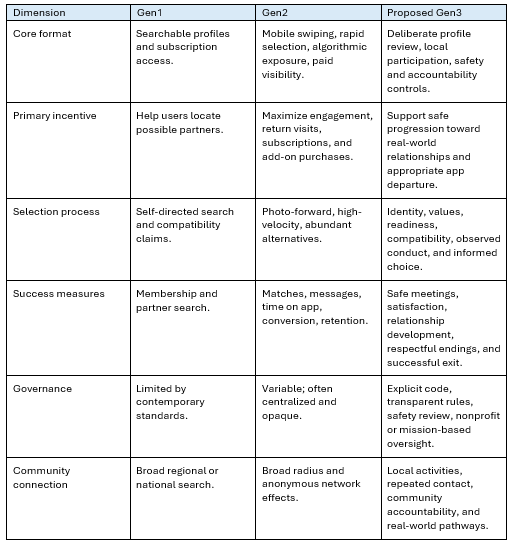
3. The Gen1, Gen2, and Proposed Gen3 Framework
The three-generation framework is a proposed analytic classification, not an established scientific taxonomy. Individual platforms may combine features from more than one generation.
4. Bend Dating as an Operational Gen3 Example
Bend Dating can be used as a bounded implementation of the proposed Gen3 model. It should not be presented as proof that the model works. It is the setting in which feasibility, public interest, use, safety, and possible outcomes can be observed.
The operational model includes:
local geographic boundaries intended to increase real-world relevance and community accountability;
identity verification, background-check options, safety procedures, and enforceable behavioral expectations;
psychology-informed screening and relationship-readiness information intended to support informed choice;
no swiping, no paid visibility, no boosts, no photo filters, and no engagement-maximizing popularity games;
limits or controls intended to reduce excessive concurrency and diffuse attention;
connections to local places, activities, events, and opportunities for repeated real-world interaction;
access to education, coaching, or qualified relationship-therapy referrals when appropriate; and
nonprofit oversight intended to reduce pressure from investors, growth targets, or profit maximization.
The immediate naturalistic question is whether a sufficient number of eligible community members will voluntarily register, complete the required processes, use the system, communicate, meet safely, and regard the model as acceptable or preferable to prior dating-app experiences.
5. Ethical Dating-App Design Model
5.1 Incentive Alignment
An ethical platform should not depend on user frustration, artificial scarcity, prolonged ambiguity, or unsuccessful relationship search. Its business and governance model should permit success to be defined by safe and satisfactory outcomes, including members leaving because they formed a relationship.
5.2 Safety and Foreseeable-Harm Reduction
Safety must be treated as a system responsibility shared with users, not shifted entirely onto them through disclaimers. Reasonable controls may include identity verification, background checks, reporting systems, pattern detection, evidence preservation, complaint review, suspension or exclusion criteria, and referral pathways. These measures reduce risk; they do not guarantee safety.
5.3 Transparency and User Autonomy
Members should understand how visibility, communication access, recommendations, screening information, data use, and account decisions operate. Paid exposure, artificial scarcity, persuasive AI, hidden ranking, or undisclosed inference from sensitive data should be prohibited or clearly disclosed and independently reviewable.
5.4 Relationship-Constructive Architecture
Design should support attention, pacing, clarity, informed consent, respectful endings, and movement into real-world interaction. Ethical design may reduce simultaneous conversations, rapid replacement cues, infinite-scroll discovery, intermittent-reward notifications, and other features that fragment attention or increase compulsive use.
5.5 Community and Human Accountability
A local model can connect digital discovery to repeated community participation, where members can observe reliability, kindness, emotional steadiness, responsibility, and treatment of others. Technology should support—not replace—embodied interaction, human judgment, and accountable conduct.
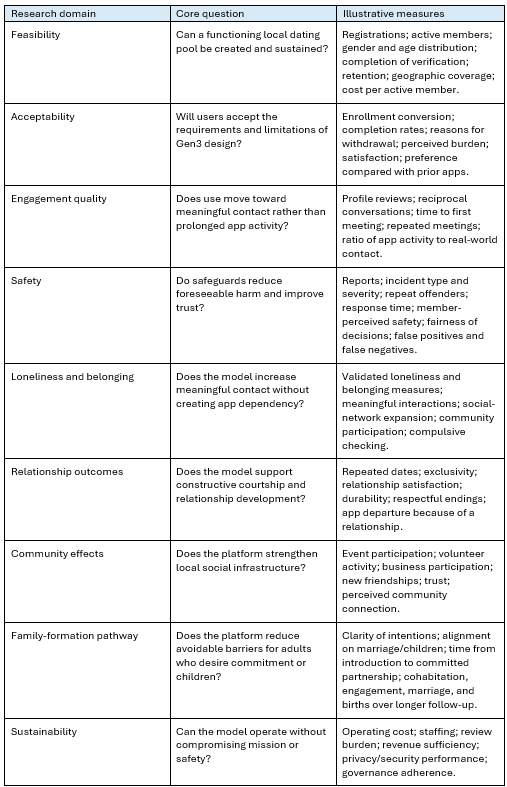
6. Bend Dating Research Program
A staged research program would permit stronger conclusions over time. Early phases should focus on feasibility and acceptability. Later phases can examine comparative outcomes if participation, data quality, ethics review, and sample size permit.
7. Loneliness, Social Isolation, and Belonging
Bend Dating may support research and intervention related to loneliness, but it should not be represented as a cure. Loneliness is heterogeneous. It may reflect limited social contact, lack of intimate attachment, grief, depression, social anxiety, trauma, disability, geographic isolation, or dissatisfaction despite frequent contact.
The defensible research question is whether a locally bounded, accountable, activity-connected platform can increase meaningful social contact and belonging while reducing dependence on app-based validation. Bend Dating can support three possible pathways:
romantic connection and progression toward a committed relationship;
friendship, activity participation, and broader community connection even when romance does not result; and
identification of members who may benefit from education, coaching, or licensed mental-health services.
Outcome measurement should distinguish objective isolation from subjective loneliness, and romantic loneliness from general social belonging. It should also assess unintended effects such as rejection sensitivity, discouragement, compulsive checking, social comparison, or exclusion from a small local network.
8. Family Formation, Fertility, and Population Trends
The relationship between dating systems and fertility decline must be framed cautiously. Housing costs, education, employment instability, childcare, health, delayed partnership, cultural preferences, and many other factors influence family formation and birth rates. It would be scientifically unsound to claim that dating apps caused depopulation or that Bend Dating can reverse it.
A more credible proposition is that digital courtship is one potentially modifiable part of the pathway from partner discovery to courtship, commitment, cohabitation, marriage, and parenthood. Research can test whether Gen3 design improves intermediate conditions needed by adults who already desire committed partnership or children, including:
earlier and clearer disclosure of relationship and family intentions;
better alignment concerning marriage, children, geography, values, and life plans;
reduced time in prolonged ambiguous or incompatible relationships;
improved trust, safety, readiness, and relational self-efficacy;
more efficient movement from digital contact to real-world courtship; and
greater persistence among people who might otherwise withdraw from dating because of burnout or low trust.
Longitudinal follow-up could eventually examine partnership, cohabitation, marriage, parenthood, and continued residence in the community. These outcomes would require years of observation, careful consent, protection of sensitive data, and appropriate comparison groups before causal conclusions could be considered.
9. Community Improvement and Public Infrastructure
Communities may contain many places and activities but still lack a trusted pathway from acquaintance to intentional dating. Public spaces rarely establish whether someone is single, emotionally available, safe, interested, or open to approach. Community groups permit repeated contact and observed character, yet they may not provide a clear transition into romantic intent.
Bend Dating can function as connective infrastructure between digital identification and community participation. It may help members discover people who are available and relationship-oriented, then move toward local activities where attraction can develop through shared purpose, repeated attendance, natural conversation, and observation of conduct.
Public-improvement outcomes may include increased participation in local events, volunteer work, recreation, arts, dance, civic activity, faith communities, and neighborhood life. The public value need not depend solely on marriage. Stronger weak ties, friendship, trust, reduced isolation, and more accountable social participation are independently meaningful outcomes.
10. Framework for State Regulation
State regulation need not dictate whom dating platforms recommend or guarantee relationship success. It can regulate commercial practices, foreseeable risks, transparency, sensitive data, safety governance, and representations of scientific validity. A model regulatory framework could include the following provisions:
Disclose the platform’s primary optimization objectives and whether payment affects visibility, ranking, or access.
Prohibit deceptive scarcity, fabricated activity, undisclosed exposure suppression, and misleading “pay-to-be-seen” practices.
Require plain-language explanations of recommendation, matching, visibility, and AI-inference systems.
Apply heightened protections to psychological, sexual, safety, relationship, and family-intention data.
Require identity-verification standards proportionate to platform risk, while protecting members from unnecessary data retention.
Require accessible reporting, preservation of relevant evidence, review of repeated complaints, documented decision authority, and timely action on credible safety concerns.
Require transparent suspension, exclusion, appeal, and reinstatement procedures, with protections against arbitrary or discriminatory enforcement.
Prohibit scientifically unsupported claims about compatibility, psychological screening, safety, or relationship success.
Require special informed consent and independent review when persuasive AI interviews users or infers vulnerabilities, attachment patterns, sexual preferences, or family goals.
Require periodic public reporting of complaints, incidents, response times, removals, appeals, and material safety-system changes, using privacy-protective aggregate data.
Require conflict-of-interest disclosure and governance controls when revenue, investor demands, or growth targets may compromise user safety.
Authorize state agencies to audit safety and data practices and impose corrective action for deceptive, unfair, or foreseeably harmful design.
Bend Dating can serve as a practical reference for which protections are operationally feasible, what burdens they create, how users respond, and which controls appear useful. It should not be treated as the only permissible model.
11. Research Design and Measurement Strategy
11.1 Naturalistic Observation
The initial project is observational. Members self-select into the platform, are not randomly assigned, and may differ substantially from users of conventional apps. Early findings should therefore be described as feasibility, acceptability, participation, safety, and outcome observations—not proof of causal superiority.
11.2 Baseline and Follow-Up
At enrollment, members can be asked about prior app use, dating burnout, loneliness, belonging, perceived safety, relationship intentions, family goals, and expectations. Follow-up can occur at predefined intervals, such as 30 days, 90 days, six months, and annually, with brief event-based assessments after meetings or relationship milestones.
11.3 Comparison Strategies
Stronger future designs may include matched comparison groups, interrupted time-series analysis, phased geographic rollout, within-person comparisons with prior app experiences, or voluntary randomization of non-safety interface features. Safety requirements should not be withheld merely to create a control condition.
11.4 Patient- and Member-Reported Outcomes
Outcome measures should be reliable, valid, useful, proportionate to burden, and interpreted cautiously. Candidate domains include loneliness, belonging, dating self-efficacy, trust, anxiety, compulsive use, perceived safety, satisfaction, hopefulness, relationship readiness, and relationship quality. Platform metrics should be linked to human outcomes rather than treated as outcomes by themselves.
11.5 Qualitative Research
Interviews and open-ended surveys can identify why people enroll or decline, which safeguards build trust, which requirements feel intrusive, how members interpret compatibility information, and what prevents movement from profile review to real-world meeting. Qualitative findings are particularly important in a small local system where numerical samples may initially be limited.
12. Governance, Ethics, and Human-Subjects Considerations
Naturalistic product observation can become human-subjects research when data are collected systematically to produce generalizable knowledge. MRI should determine, with qualified review, whether particular projects require institutional review board review or another formal ethics process. Publicly describing the platform as research does not by itself resolve that question.
Minimum safeguards should include:
clear separation of ordinary platform operations from optional research participation when feasible;
informed consent describing what data will be collected, why, how long they will be retained, and who may access them;
privacy-by-design, data minimization, encryption, role-based access, and breach-response procedures;
protection against coercion, especially when access to dating services is linked to research participation;
independent review of safety incidents, conflicts of interest, and adverse findings;
predefined rules for publishing unfavorable as well as favorable results;
careful language distinguishing screening from diagnosis and education or coaching from psychotherapy;
prohibition against using sensitive screening data for hidden advertising, paid visibility, or unrelated commercial purposes.
13. Limitations and Claims That Should Not Be Made
The framework supports hypothesis generation and structured observation. It does not currently establish that:
Gen2 dating apps cause harm in every user or are the primary cause of loneliness, delayed marriage, or fertility decline;
Bend Dating prevents assault, fraud, emotional harm, or unsafe relationships;
psychological screening can determine who will be a good partner or guarantee compatibility;
local accountability eliminates deception, bias, exclusion, or reputational harm;
greater participation, satisfaction, or app preference proves better long-term relationship outcomes;
a single community demonstration can be generalized to all ages, identities, cultures, or geographic regions.
The appropriate language is that the model is designed, intended, or hypothesized to improve specific processes and reduce particular risks. Claims of effectiveness should follow evidence, not precede it.
14. Companion Papers
There are four Mentor Research Institute papers that describe the Bend Dating App Initiative.
“Assessing Public Interest in a Safer, More Accountable, Relationship-Outcome-Oriented Gen3 Dating App” is a concise naturalistic-observation overview.
For more information see:
https://www.mentorresearch.org/assessing-public-interest-in-a-safer-more-accountable-relationship-outcome-oriented-gen3-dating-app
“Definitions and Constructs to Comprehend and Understand Dating App Design for Profit” is a conceptual vocabulary and theoretical foundation.
For more information see:
https://www.mentorresearch.org/definitions-and-constructs-to-comprehend-and-understand-dating-app-design-for-profit
“Why was BendDating.com Created?” describes the local mission, community, loneliness, and family-formation rationale
For more information see:
https://www.mentorresearch.org/why-bend-dating-was-created-a-local-answer-to-a-loveless-dating-economy
Conclusion
The principal contribution of Bend Dating is its capacity to make dating-app design observable, governable, testable, and continuously improvable. It provides a real-world setting for examining a locally bounded, relationship-outcome-oriented platform created to improve safety, trust, social connection, courtship, partnership formation, and community well-being.
The Definitions and Constructs paper identifies specific mechanisms through which dating-app design can shape user behavior and outcomes, including uncertainty, opacity, emotional extraction, weak safety incentives, interaction velocity, concurrency, and the tension between platform retention and relationship resolution. The Gen3 framework converts these mechanisms into explicit design standards, governance requirements, research questions, measurable outcomes, and potential consumer protections.
Bend Dating can improve safety by reducing foreseeable risk through identity verification, background checks, screening, clear conduct standards, complaint review, local accountability, privacy protections, and referrals to qualified professionals. It can improve informed choice by providing users with more complete information about identity, intentions, relational readiness, compatibility, and behavioral expectations. It can improve relationship processes by reducing gamification, excessive concurrency, paid visibility, algorithmic manipulation, and rapid replacement cues.
The platform can also support social connection by creating clearer pathways from digital discovery to real-world meetings, local activities, community participation, friendship, dating, and committed relationships. Its effects can be evaluated through measures of loneliness, belonging, perceived safety, trust, meaningful interaction, dating self-efficacy, in-person meetings, relationship formation, satisfaction, and appropriate departure from the platform.
A staged research program will establish feasibility, participation, demographic balance, acceptance of safeguards, and sustained use. It can then evaluate safety, social connection, relationship processes, community participation, partnership formation, marriage, family development, and longer-term demographic implications. The resulting evidence can guide platform improvement, ethical app design, public education, consumer protection, state regulation, replication in other communities, and future research.
Bend Dating therefore offers a practical model for determining how ethical digital courtship can reduce risk, strengthen accountability, support meaningful relationships, and function as socially beneficial public infrastructure.
References and Related MRI Papers
Mentor Research Institute. (2026). Assessing Public Interest in a Safer, More Accountable, Relationship-Outcome-Oriented Gen3 Dating App: A Naturalistic Observation Research Model.
https://www.mentorresearch.org/assessing-public-interest-in-a-safer-more-accountable-relationship-outcome-oriented-gen3-dating-app
Mentor Research Institute. (2026). Definitions and Constructs to Comprehend and Understand Dating App Design for Profit.
https://www.mentorresearch.org/definitions-and-constructs-to-comprehend-and-understand-dating-app-design-for-profit
Mentor Research Institute. (2026). Why Bend Dating Was Created: A Local Answer to a Loveless Dating Economy.
https://www.mentorresearch.org/why-bend-dating-was-created-a-local-answer-to-a-loveless-dating-economy
Mentor Research Institute. MRI Disclaimer and Explainer: Dating-App Risk and Harm.
https://www.mentorresearch.org/
Pew Research Center. (2020). Nearly half of U.S. adults say dating has gotten harder for most people in the last 10 years.
https://www.pewresearch.org/social-trends/2020/08/20/nearly-half-of-u-s-adults-say-dating-has-gotten-harder-for-most-people-in-the-last-10-years/
Pew Research Center. (2023). From looking for love to swiping the field: Online dating in the U.S.
https://www.pewresearch.org/internet/2023/02/02/from-looking-for-love-to-swiping-the-field-online-dating-in-the-u-s/