Not Just a Promise: How Bend Dating Builds and Tests Safety
Legitimate Assurance and Best-in-Class Community Protection Design
Mentor Research Institute, August 2026
Summary
Bend Dating operates as a controlled-membership community in which access is conditioned on identification, disclosure, background checks, enforceable conduct standards, and acceptance of institutional accountability. Bend Dating was developed as a local, nonprofit, accountability-oriented alternative to conventional dating applications. Its seven accountability layers do not merely provide optional safety features after a person has entered the platform. They establish a controlled gate. A prospective member must accept identity-linked participation, substantive disclosure, enforceable conduct standards, screening requirements, community accountability, and the possibility of investigation, suspension, expulsion, and prevention of reentry. This design materially changes who can enter, how anonymously a person can act, and what consequences may follow misconduct.
The Risk-Impacting Objectives (RIO) analysis translates this protective model into an auditable system. Twelve objectives are linked to sixteen defined risks and thirty controls. The analysis evaluates not only whether a control exists, but whether the seven layers operate together as a coherent gatekeeping, deterrence, detection, response, and learning system. The intended result is legitimate assurance: a reasonable, evidence-supported basis for confidence that Bend Dating is designed and governed to reduce preventable harm, while avoiding the false claim that any platform can guarantee individual safety.
The evidence supports this affirmative conclusion. Public-health guidance favors comprehensive strategies that combine protective environments, healthy relationship skills, clear norms, consistently applied policies, monitoring, and victim-centered response. Deterrence research gives particular weight to the perceived certainty of identification, detection, and consequences. Collective-efficacy research supports the protective value of shared standards and willingness to intervene within a bounded community. Dating-platform research documents online and offline sexual harm and repeat victimization, demonstrating the need for identity-linked reporting, pattern detection, removal, and reentry prevention. [8, 9, 10, 11, 12, 16, 17, 18, 19, 20]
Among the major platforms reviewed for this report, Tinder, Bumble, Hinge, and Match Group publicly describe important safeguards such as photo or optional identity verification, automated moderation, reporting, blocking, message prompts, safety education, date sharing, and centralized safety review. Those measures are meaningful. However, the reviewed platforms do not publicly describe the same complete combination of mandatory identity-linked entry, optional but controlled background screening, scientifically developed relationship information, competence and life-profile information, qualified professional referral, locally accountable reporting and mitigation, nonprofit mission lock, and systematic RIO testing. Bend Dating, a non-profit charitable enterprise, concludes based on reason and declarative facts, that an open gate and access to members is an unacceptable risk and in some cases dangerous to the safety and well-being of the Bend ecosystem. On the available evidence, Bend Dating therefore qualifies as a best-in-class design among the platforms reviewed: not because every individual control is unique, but because the seven layers are integrated, mandatory where essential, locally governed, and auditable. [21, 22, 23, 24]
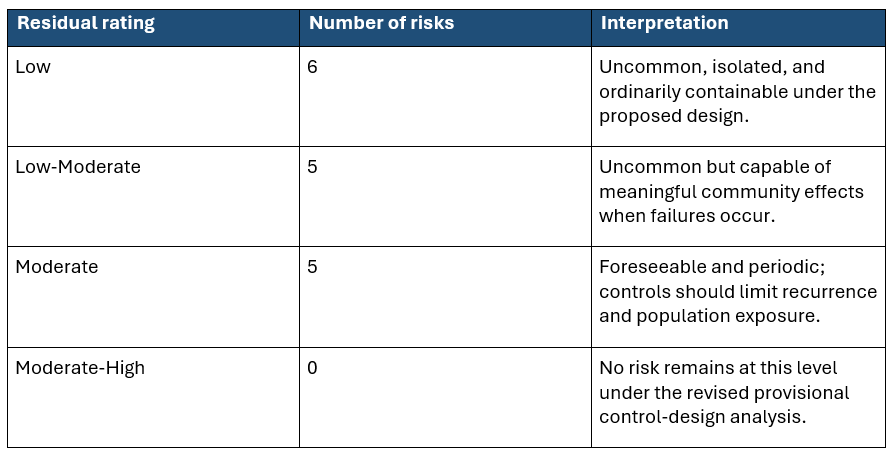
Summary of Risk-Library Residual-Risk Results (BD.R001–BD.R016)
The central finding is not simply that residual risks remain. It is that the proposed control environment closes access to people unwilling to accept identification and accountability, raises the expected cost of misconduct, makes repeated behavior easier to connect to a stable identity, and enables the institution to remove and exclude members who violate standards. The RIO therefore supports a positive assurance conclusion: the model is reasonably designed to move the community risk profile in a safer direction and to generate evidence showing whether that protection is consistently delivered.
Legitimate assurance does not mean that Bend Dating can certify that every member is safe or guarantee that no harmful event will occur. It means there is a reasonable, research-supported basis for confidence that the seven-layer architecture is materially more protective, accountable, and testable than a system relying principally on self-description, optional verification, blocking, and safety advice. The RIO analysis is the mechanism for determining whether this assurance remains justified in practice.
The controls are expected to work through several mechanisms. Entry friction can close the gate to people unwilling to be identified or held accountable. The perceived certainty that conduct can be reported, attributed, investigated, and followed by consequences can deter misconduct. A small, bounded community can make continued membership more valuable, improve recognition of repeated patterns, and strengthen both formal and informal accountability. Reporting and response can limit duration, recurrence, and the number of additional members exposed even when an initial event cannot be prevented.
Design effectiveness asks whether a control has a plausible mechanism for reducing a defined risk. For example, identity verification can reduce anonymous access and support attribution; reporting can increase detection and deterrence; rapid restriction can reduce continuing exposure; expulsion and reentry prevention can reduce recurrence; and independent incident review can identify systemic failure. Operating effectiveness asks whether those controls actually occurred as required: whether verification was completed, reports were accessible, triage was timely, evidence was preserved, sanctions were consistent, duplicate accounts were detected, and corrective actions were completed.
The effectiveness of Bend Dating’s safety system cannot be established by the existence of written policies alone. A control is effective only when it is properly designed, consistently implemented, adequately supported, used by members and personnel, documented, reviewed, and corrected when it fails. The RIO therefore distinguishes control design from operating effectiveness. The operation effectiveness is a high priority
Effectiveness of Safety and Accountability Controls
The model also addresses a structural concern: a dating institution may possess the power to verify, restrict, investigate, connect information, and remove access, yet leave the individual to bear nearly all responsibility for managing unequal risk. Bend Dating is designed to redistribute that responsibility by increasing institutional information, accountability, and corrective capacity.
The RIO was developed to address risk conditions that are not adequately resolved by ordinary profile matching or isolated safety tips. These risks include false identity and disposable accounts; profile deception and material omission; harassment and unwanted contact; sexual coercion, stalking, assault, coercive control, and dating violence; romance fraud and financial exploitation; inaccessible or distrusted reporting; delayed, biased, or poorly documented investigations; repeat offending and reentry after removal; unfair or inaccurate screening; misuse of psychological information; privacy and cybersecurity failures; unqualified professional services; mission drift; and weak governance or vendor oversight.
Central Concerns Addressed by the Model (BD.CC01–BD.CC15)
ID and protective domain
Definition for the Bend Dating RIO
BD.CC01: Governance
The structure through which Bend Dating’s mission, policies, authority, accountability, oversight, conflicts of interest, risk tolerance, and major decisions are established and controlled. Governance includes board responsibility, management authority, documented policies, independent review, and protection against mission drift.BD.CC02: Member Eligibility
The documented requirements a person must satisfy to apply for, obtain, retain, suspend, restore, or terminate Bend Dating membership. Eligibility criteria should be objective, consistently applied, relevant to the platform’s purpose, and subject to a fair review or appeal process.BD.CC03: Identity and Account Integrity
The controls used to reasonably confirm a member’s identity and age, prevent impersonation and duplicate accounts, maintain accurate account ownership, and prevent suspended or expelled members from improperly reentering the platform. Identity verification establishes accountability but does not certify that a person is safe.BD.CC04: Background Screening
The lawful and controlled process for obtaining, reviewing, communicating, and responding to relevant background information. Screening should define the records searched, limitations, review standards, correction procedures, privacy protections, and how information may be used. It is not a complete history or a guarantee of safety.BD.CC05: Relationship Information
Scientifically developed and responsibly presented information intended to improve self-knowledge and informed dating decisions, including personality, character strengths, mindfulness, communication style, relationship expectations, and related factors. It must not be presented as diagnosis, violence prediction, or certification of compatibility or safety.BD.CC06: Member Education
The information and instruction provided to members about platform expectations, consent, boundaries, safe communication, fraud prevention, reporting, privacy, dating safety, available resources, and the limits of Bend Dating’s controls.BD.CC07: Conduct
The behavioral standards members agree to follow, including honesty, respect, consent, appropriate communication, boundary recognition, nonviolence, nonexploitation, and compliance with platform rules. Conduct standards define prohibited behavior and provide the basis for corrective action.BD.CC08: Reporting
The accessible and confidential process through which members or others may communicate suspected misconduct, safety concerns, policy violations, control failures, retaliation, or institutional problems to Bend Dating. Reporting includes intake, documentation, triage, acknowledgment, escalation, and protection against retaliation.BD.CC09: Investigation
A fair, timely, impartial, and documented process for evaluating a report, collecting and preserving relevant information, interviewing appropriate persons, assessing credibility, reaching findings, and identifying necessary protective or corrective action.BD.CC10: Enforcement
The consistent application of consequences and protective actions when eligibility requirements, conduct standards, or safety policies are violated. Enforcement may include education, warnings, restrictions, suspension, removal, referral, reentry prevention, or other proportionate action, together with appropriate appeal rights.BD.CC11: Privacy
The policies and controls governing what personal information Bend Dating collects, why it is collected, how it is used, who may access it, when it may be disclosed, how long it is retained, and how members may exercise applicable rights. Privacy requires data minimization, informed consent, purpose limitation, and protection against unauthorized secondary use.BD.CC12: Cybersecurity
The administrative, technical, and physical safeguards used to protect Bend Dating systems and information from unauthorized access, alteration, disclosure, destruction, fraud, disruption, and loss. Cybersecurity includes access controls, authentication, encryption, monitoring, backups, incident response, vendor security, and recovery planning.BD.CC13: Professional Referrals
The controlled process for identifying and referring members to certified dating coaches, relationship therapists, mental-health professionals, crisis resources, or other appropriate services. Referral standards should address qualifications, scope of practice, conflicts of interest, informed choice, confidentiality, and separation from membership or investigative decisions.BD.CC14: Measurement
The systematic collection and analysis of information used to determine whether Bend Dating’s controls are implemented as designed and whether they produce intended results. Measurement may include participation, verification, reporting, response time, recurrence, member trust, perceived safety, control failures, and community-level outcomes.BD.CC15: Continuous Improvement
The recurring process of using reports, investigations, testing, member feedback, outcome data, incidents, appeals, audits, and external evidence to identify weaknesses and improve policies, controls, training, technology, staffing, and governance. Continuous improvement converts experience into documented corrective and preventive action.
The seven layers are complementary. Identity verification does not replace background screening. Background screening does not replace relationship information. Relationship information does not replace conduct standards. Conduct standards have limited value without reporting and enforcement. Reporting has limited value without verified identity, timely response, sanctions, and reentry prevention. The protective effect arises from the integrated system and the consistent operation of each layer.
Code of Conduct. The Code is the first form of shared knowledge. It defines honesty, consent, boundaries, communication, nonviolence, prohibited conduct, reporting duties, and consequences. Its value depends on clear communication and consistent enforcement.
Identity verification. Identity and age verification reduce anonymous and disposable participation, allow reports to be attributed to a stable person, support pattern detection, make expulsion consequential, and strengthen prevention of duplicate or evasive reentry.
Competence and life profile. Members may provide information concerning experience, employment, training, service, education, strengths, purpose, achievement, recreation, and other indicators of how they function in life. This layer provides context about capacity, stability, responsibility, and compatibility without reducing a person to a single score.
Relationship screening. Scientifically developed measures of personality, character strengths, mindfulness, communication, and relationship functioning provide structured information that ordinary dating profiles do not. These measures are intended to support knowledge and informed choice, not diagnose mental illness or predict who will commit violence.
Background screening. Controlled background information can identify relevant records and support informed decisions and safety review. It is a separate layer from identity verification and relationship evaluation. It must be lawful, accurate, limited, reviewable, and never described as proof that a person is safe. Background screening is optional under the controlled Bend Dating design.
Referrals to qualified professionals. Certified dating coaches and relationship therapists can provide education, consultation, coaching, or psychotherapy within defined professional scopes. Credentialing, ethical standards, continuing education, conflicts rules, complaint procedures, and member choice are necessary to make this a genuine accountability layer rather than a marketing referral.
Reporting and mitigation of risk. Members can categorize, describe, and report suspected violations. Bend Dating can triage, protect, investigate, decide, warn, restrict, suspend, expel, hear appeals, prevent reentry, connect separate reports, review serious incidents, and improve the system. This layer converts information into institutional action.
The Bend Dating model is organized around seven distinct but mutually reinforcing layers:
This approach extends accountability beyond the person directly involved in an incident. A report may reveal a repeat offender, a weak control, an unclear rule, a delayed response, a vendor failure, or a pattern affecting several members. The relevant question is not only whether one member made a good decision. It is whether Bend Dating used the knowledge and authority available to prevent recurrence, reduce the number of people exposed, correct the control failure, and strengthen the community.
Traditional dating app safety is treated as a shared institutional and community function. Bend Dating assumes responsibility for designing the gate, defining acceptable conduct, verifying identity, controlling account access, providing relevant information, receiving and connecting reports, responding to risk, enforcing consequences, preventing reentry, and learning from failures. Members retain agency over whom they contact, meet, and date, while the institution assumes responsibility for the integrity of the environment it creates and maintains.
Conventional dating systems often place the practical burden of safety on the individual: inspect a profile, detect deception, recognize coercion, arrange a safe meeting, preserve evidence, block the person, and decide whether and where to report. Bend Dating does not eliminate personal judgment or responsibility, but it rejects the premise that individuals should be left alone to manage risks that the institution has the power to reduce.
Safety and Accountability Extend Beyond Individual Responsibility
After admission, members use relationship-oriented information and defined communication tools to make informed choices. Bend Dating limits access to people who accept the duties of membership and establishes institutional responsibility for maintaining the conditions under which members meet. When concerns arise, members can report conduct through a defined process. Bend Dating can then triage risk, preserve information, impose temporary protective restrictions, investigate, make findings, apply proportionate sanctions, hear appeals, detect patterns, expel members when warranted, and prevent return through deceptive or duplicate accounts. The application is therefore only one part of the system; governance, policy, trained human review, community standards, and corrective action are equally important.
The operating sequence begins with informed entry. A prospective member receives the mission, membership requirements, Code of Conduct, privacy and safety limitations, and consequences for violations. The person must complete the required identity and age verification, provide the required profile and relationship information, acknowledge the standards governing honesty, consent, boundaries, communication, and nonviolence, and accept that reports may be investigated and may result in warning, restriction, suspension, expulsion, and prevention of reentry. Background screening is an additional, controlled source of information and is not represented as a guarantee of safety. Mental-health screening, where offered, is for the member’s personal use only and is not used to determine eligibility, visibility, compatibility, readiness, or dangerousness. It does provide self-awareness of conditions that may have a negative impact of outcomes.
Bend Dating is designed as a local, nonprofit, controlled-membership dating community rather than an open-access marketplace organized principally around volume, swiping, advertising, or prolonged engagement. A person does not simply download the application, create a minimally verified profile, and gain unrestricted access to other members. Membership is conditioned on accepting identifiable, enforceable, and reviewable obligations. The model intentionally places a gate between the general public and the member community.
Introduction: How Bend Dating Works
1. Purpose and Scope of the RIO
A Risk-Impacting Objectives analysis begins with the objectives an enterprise must achieve, rather than beginning with a free-standing list of hazards. A risk is therefore defined by its capacity to prevent an objective, weaken an intended condition, or cause harm to member or community health, safety, trust, participation, or institutional integrity. A control is a policy, procedure, system feature, assigned responsibility, or review activity intended to prevent, detect, contain, correct, or learn from that risk.
The Bend Dating RIO evaluates whether the proposed enterprise is reasonably designed to provide a safer, more accountable, transparent, and relationship-oriented dating environment. It covers governance, member eligibility, identity and account integrity, background screening, relationship information, member education, conduct, reporting, investigation, enforcement, privacy, cybersecurity, professional referrals, measurement, and continuous improvement. These fifteen central concerns are assigned the stable identifiers BD.CC01 through BD.CC15 in that order in the latest spreadsheet.
The analysis is intentionally community-oriented. An individual assault or stalking event may be severe or catastrophic for the affected person. The community-impact rating instead asks whether the condition is isolated or recurring, how many people may be exposed, how long the condition persists, whether repeat victimization or repeat offending occurs, and whether community trust and participation are materially damaged.
2. RIO Components
Goals: Broad public-interest outcomes, including a safer pathway to relationships, ethical nonprofit operation, informed choice, accountability, privacy, and stronger community relationships.
Objectives: Specific conditions Bend Dating must establish or maintain. Each objective is uniquely identified, source-supported, and capable of being audited.
Risk Library: Standardized cause-event-impact statements describing what may prevent an objective or create community harm. Each risk is mapped to objectives and sources.
Control Library: Defined preventive, detective, corrective, governance, technical, and monitoring activities. Each control has an owner, frequency, nature, and risk mapping.
Risk Control Matrix: The traceability mechanism connecting each risk to its objectives, controls, proposed testing, findings, recommendations, and residual-risk conclusion.
Residual-Risk Analysis: The reasoned estimate of the community risk expected to remain after considering control design and, later, operating effectiveness.
Risk Velocity and Mitigation Responsiveness: Velocity describes how quickly harm can begin. Responsiveness describes how quickly Bend Dating can detect, restrict, investigate, contain, sanction, and prevent recurrence.
2.1 Key RIO Terms
These concepts are used consistently in an Excel RIO workbook and this report. The Risk Library expresses residual-risk conclusions through qualitative categories, while the latest central-concern bubble map expresses residual certainty, community impact, and responsiveness through 1–5 ordinal ratings. Their definitions are specific to Bend Dating’s community-level risk analysis and should not be interpreted as actuarial classifications of individual members.
ID: A unique reference code assigned to an objective, risk, control, source, central concern, or other RIO component so it can be consistently identified, mapped, tested, and tracked. The prefix identifies the component type. For example, BD.CC12 identifies the central concern Cybersecurity in the latest bubble-map spreadsheet, while BD.R016 identifies the Risk Library entry for sexual assault, stalking, coercive control, and dating violence.
Risk: An uncertain event, behavior, condition, or control failure that could prevent Bend Dating from achieving an objective or cause harm to members, community health and safety, public trust, or institutional integrity.
Inherent risk: The level of risk expected before considering Bend Dating’s seven accountability layers and related protective controls. It reflects the likelihood and potential effect of the risk in an ordinary dating environment without the proposed safeguards.
Residual certainty: The expected frequency, recurrence, persistence, or population exposure that remains after considering the design and expected operation of Bend Dating’s controls. It is a community-level estimate, not a prediction that a particular member will cause harm.
Community impact: The expected cumulative effect of a risk on the Bend Dating community, including the number of people exposed, seriousness and duration of harm, repeat victimization, member participation, trust, institutional functioning, and broader community safety. It is distinct from the severity of a single event for an individual.
Responsiveness: The speed and effectiveness with which Bend Dating can receive, detect, triage, contain, investigate, sanction, correct, and learn from a risk event, including its ability to prevent repeat exposure or reentry after corrective action.
Residual risk: The overall level of community risk reasonably expected to remain after considering residual certainty, community impact, mitigation responsiveness, and the strength of the applicable controls. It is neither a certification of individual safety nor a guarantee that a harmful event will not occur.
3. Development of the Bend Dating RIO
3.1 Source development
The objectives and proposed institutional structure were derived principally from Mentor Research Institute’s Bend Dating papers and policy documents. These sources describe a nonprofit, community-rooted model based on identity accountability, background screening, relationship information, enforceable conduct standards, professional resources, reporting, safety oversight, privacy, and continuous improvement. [1, 2, 3, 4, 5]
External sources were used to test whether the risk environment and proposed protective mechanisms were plausible. Pew Research documents unwanted sexual messages, continued contact after disinterest, insults, threats, and substantial public concern about online-dating safety. [6] The Federal Trade Commission describes recurring romance-scam patterns, including false profiles, rapid emotional escalation, movement off platform, and requests for money. [7]
The revised analysis added sexual-violence and dating-violence sources. The Australian Institute of Criminology surveyed 9,987 dating-app or website users and reported extensive online and in-person dating-app-facilitated sexual violence, including repeat victimization. [10] CDC guidance identifies weak institutional support and weak community sanctions as community-level risk factors and recommends protective environments, consistently applied policies, healthy dating and intimate-relationship skills, and victim-centered services. [8, 9, 11] WHO emphasizes proactive, evidence-informed prevention and rigorous evaluation while acknowledging that imperfect evidence does not justify inaction. [12]
3.2 Objective development
Twelve objectives were drafted as auditable conditions rather than general aspirations. Examples include verifying member identity and account integrity; using background information fairly; providing appropriately limited relationship information; supporting informed and autonomous decisions; preventing and responding to interpersonal harm; providing accessible and fair reporting and investigation; protecting sensitive information; measuring safety and relationship-oriented outcomes; and maintaining accountable governance.
The objective concerning interpersonal harm was expanded to expressly include sexual assault, stalking, coercive control, threats, and physical violence occurring online or after an in-person meeting. This change recognizes that a dating platform can facilitate identification, contact, grooming, meeting, repeated access, or evasion even when the ultimate harm occurs offline. [10]
3.3 Risk development
Sixteen risks were defined using cause-event-impact reasoning. The revised risk library distinguishes lower-level harassment and boundary violations from serious sexual assault and dating violence. This prevents common unwanted communication from obscuring high-consequence violence and ensures that serious incidents receive different controls, escalation pathways, referrals, governance review, and residual-risk treatment.
For example, repeated unwanted messages after disinterest may be frequent but readily contained through blocking, warning, suspension, and expulsion. Sexual assault, stalking, coercive control, or physical violence may be less frequent, but the consequences are more durable, may occur offline, and cannot be undone by later account action. The risks therefore require separate ratings and control sets.
3.4 Control development
Thirty proposed controls were mapped to the sixteen risks. The controls include entry friction, Code of Conduct acknowledgment, identity and age verification, duplicate-account and evasion detection, background-screening standards, relationship-evaluation limitations, profile attestation, member education, accessible reporting, safety triage, structured investigations, sanction consistency, appeals, pattern analytics, privacy governance, cybersecurity, vendor oversight, professional credentialing, measurement protocols, and independent corrective-action review.
Six controls were added specifically for sexual assault and dating violence: an express prohibition; a consent, coercion, and healthy-relationship standard; immediate high-risk protective action; trauma-informed communication and referral; expulsion and reentry prevention; and independent review of serious incidents, repeat victimization, repeat-offender indicators, and control failures. These controls are consistent with public-health recommendations to create protective environments, apply policies consistently, teach healthy relationship skills, and provide victim-centered services. [8, 9, 11]
3.5 Provisional implementation and scoring
The current residual ratings are a demonstration baseline based on proposed control design. A control was credited when it had a plausible causal connection to the risk, defined ownership and timing, complementary preventive, detective, or corrective coverage, and a reasoned capacity to reduce recurrence, persistence, or population exposure. The analysis did not assume that a written control proves implementation.
For the Risk Library, residual certainty was rated Low Risk, Moderate Risk, or Almost Certain. Community impact was rated Minimal Harm, Moderate Harm, Moderately Severe Harm, or Catastrophic Harm. The latest central-concern bubble map uses a separate 1–5 ordinal display: residual certainty ranges from 1 Rare to 5 Very likely or persistent; community impact ranges from 1 Minimal to 5 Catastrophic or systemic; and responsiveness ranges from 1 Very weak to 5 Very strong and timely. Mitigation responsiveness is evaluated separately because a harmful event may occur immediately while institutional reporting and enforcement may still rapidly contain repeat exposure and recurrence.
3.6 Deterrence, reporting credibility, and the small-community effect
The revised RIO treats several Bend Dating safeguards as preventive controls rather than only post-incident responses. Entry friction may produce an entry selection effect by discouraging prospective members who want anonymity, disposable access, rapid exploitation, or freedom from accountability. Identity verification, substantial profile completion, acknowledgment of enforceable standards, and awareness of reporting and expulsion make the costs of misconduct visible before full participation.
Reporting also has a preventive function when it is credible. A prospective offender may behave differently when the platform can connect a report to a verified identity, link multiple reports, impose restrictions, expel a member, and prevent reentry. Deterrence research indicates that perceived certainty of detection is generally more influential than punishment severity alone. [16] Focused-deterrence research similarly emphasizes clear expectations, monitoring, consequences, and follow-up. [17] Bend Dating therefore treats accessible reporting as a preventive, detective, and corrective control.
The bounded Bend community may amplify these effects. Collective efficacy refers to mutual trust combined with a willingness to intervene for the common good. Research associates stronger collective efficacy with lower violence and stronger informal social control. [19, 20] In Bend Dating, a verified and bounded membership may make repeated patterns easier to recognize, increase the value of continued membership, reduce the ease of anonymous reentry, and strengthen both formal sanctions and informal expectations.
The #MeToo movement is not itself a Bend Dating control. It is a contextual social-norm protective factor. Pew found that most adults believed people committing sexual harassment or assault were more likely to be held responsible and that people reporting misconduct were more likely to be believed than five years earlier. [18] Bend Dating’s formal reporting and enforcement mechanisms operate within this changed social environment and may therefore receive greater use and legitimacy than an analysis based only on older assumptions about silence and institutional inaction.
3.7 Gatekeeping, Access Closure, and Legitimate Assurance
Bend Dating should be understood as a controlled-membership community rather than an open-access marketplace. The seven layers create a sequence of gates. A person who is unwilling to verify identity, accept enforceable standards, provide required information, tolerate review, or risk expulsion and blocked reentry does not receive the same access available on a low-friction platform. Practically, this closes the gate to at least some people who prefer anonymity, disposable accounts, rapid access, or freedom from institutional accountability.
The RIO does not need to prove that every person with a criminal history will avoid identification. That would be an overgeneralization. The defensible inference is narrower and stronger: identification and accountability impose a cost on people who benefit from concealment. A person contemplating deception, coercion, harassment, or repeated misconduct must consider that Bend Dating can connect reports to a verified identity, preserve a record, identify patterns, impose sanctions, remove access, and make reentry more difficult. The social-media environment may further increase the perceived reputational cost of being publicly associated with misconduct, even though Bend Dating itself must protect confidentiality and avoid informal public accusation or trial by social media.
Legitimate assurance is therefore produced by the combined architecture, not by a claim that any one layer predicts violence. Identity verification supports attribution. Background screening supplies relevant historical information without certifying safety. Relationship evaluations and competence information improve informed choice without labeling dangerousness. The Code of Conduct establishes norms. Reporting and investigation convert those norms into enforceable obligations. Expulsion and reentry prevention make consequences durable. Professional referral and governance provide support, oversight, and correction. The RIO tests whether these components are present, consistently implemented, and mutually reinforcing.
This approach also avoids the low-base-rate error associated with individual violence prediction. Bend Dating does not need an actuarial score that purports to identify future offenders. It can instead reduce opportunity, anonymity, recurrence, and exposure across the membership population. The relevant evidence is whether fewer unsafe or deceptive accounts enter, whether members perceive accountability as credible, whether concerns are reported earlier, whether repeated conduct is detected, whether sanctions are consistent, and whether fewer additional members are exposed after the first warning sign.
Best-in-class assurance is a comparative design conclusion, not a guarantee of outcomes. It means the reviewed design is more comprehensive, integrated, accountable, and testable than the publicly described safeguards of the comparison platforms. The conclusion should be reviewed if another platform demonstrates an equivalent or stronger integrated model, or if Bend Dating fails to implement its own controls with fidelity.
4. Results of the Risk-Library Analysis
4.1 Overall pattern
The proposed controls produced a substantial modeled reduction from inherent risk to residual community risk. Of the sixteen Risk Library entries, six were rated Low, five Low-Moderate, and five Moderate. No risk was reduced to zero, and no finding should be interpreted as a guarantee of individual safety. The revised distribution reflects stronger recognition that entry friction, identity-linked accountability, credible reporting, meaningful consequences, and a bounded local community can affect both who enters and how members behave after entry. These results use the BD.R001 through BD.R016 identifiers and are distinct from the fifteen BD.CC central concerns displayed in the latest bubble-map spreadsheet.
The pattern reflects two principles. First, formal institutional controls can meaningfully reduce community exposure even where they cannot prevent every initial event. Second, risks involving deception, off-platform conduct, serious violence, or human judgment retain greater residual uncertainty because determined actors can evade controls and because harm may occur before the institution has an opportunity to respond.
4.2 Risks rated Low
The following risks were provisionally rated Low: Unclear or inconsistently enforced conduct standards, Overstatement or misuse of relationship evaluations, Harassment, unwanted contact and boundary violations, Underreporting, retaliation or inaccessible reporting, Unqualified, conflicted or out-of-scope professional services, Invalid or misleading outcome and safety claims.
These ratings do not mean the events will never occur. They mean the proposed design should make systemic or recurring community exposure uncommon and containable. For example, unwanted messages may still be sent. However, clear standards, member education, accessible reporting, graduated enforcement, pattern analysis, and expulsion can prevent a single member’s conduct from becoming a persistent community condition.
4.3 Risks rated Low-Moderate
Background-screening errors, investigative failure, privacy misuse, cybersecurity compromise, and governance or vendor oversight failure were rated Low-Moderate. These risks are expected to be uncommon under the proposed design, but a failure could still affect multiple members or materially weaken trust. Their residual impact remains Moderate rather than Minimal because Bend Dating would hold sensitive identity, screening, communication, and safety information and would exercise consequential membership authority.
Example: an inaccurate background record could lead to unfair exclusion. The controls: verification of records, individualized review, documented rationale, appeal, vendor due diligence, and independent testing: reduce the likelihood of widespread unfairness. They do not eliminate the possibility that one person will experience a consequential error.
4.4 Risks rated Moderate
BD.R001: Mission drift and conflicting incentives: Mission-lock, nonprofit governance, independent review and outcome monitoring should limit community-wide mission drift, but financial and reputational pressures remain foreseeable.
BD.R003: False identity, impersonation or duplicate accounts: Identity verification and duplicate-account detection should materially reduce false identities and repeat entry, but sophisticated evasion remains possible.
BD.R006: Profile deception and material omission: Identity checks, attestation and enforcement should reduce material deception, but selective self-presentation and omission are inherent in dating and will continue periodically.
BD.R008: Romance fraud and financial exploitation: Entry friction, identity controls, fraud education and rapid protective action should reduce repeated community exposure, although determined off-platform social engineering remains foreseeable.
Example: False identity and reentry. Identity verification may stop many false accounts, while duplicate detection and reentry controls may identify an expelled person attempting to return. A sophisticated actor may still use compromised credentials, manipulated images, or another person’s information. The controls therefore reduce, but do not eliminate, the risk.
Example: Romance fraud. Fraud education may help a member recognize rapid emotional escalation, off-platform movement, and requests for money. Reporting may allow Bend Dating to restrict the account and identify related complaints. Yet a determined actor can continue social engineering outside the platform. The residual community risk remains Moderate because periodic incidents are foreseeable even when repeated exposure is reduced. [7]
4.5 Sexual assault, stalking, coercive control, and dating violence
This risk was rated Critical inherent risk and Moderate residual community risk. Residual certainty is Moderate Risk, residual community impact is Moderate Harm, and mitigation responsiveness is High. The revision does not minimize the severity of an individual assault. It changes the estimate of aggregate community exposure after accounting for the combined preventive and responsive effects of the Bend Dating control environment.
The Moderate residual rating is deliberate. Strong controls can reduce the number of people exposed to the same actor, shorten uncontrolled access, detect patterns, support immediate restrictions, preserve evidence, facilitate referral, expel a substantiated offender, and reduce reentry. The revised analysis also recognizes that these controls may prevent some events before they occur by discouraging anonymous or low-accountability participation and increasing the perceived certainty of detection and consequence. They cannot reverse an assault, guarantee that a member will report, ensure that an event will occur on-platform, or prevent all offline violence. The cumulative effect of even a limited number of serious incidents may still materially affect community trust and participation.
Example: A member reports stalking and sexual coercion following an in-person meeting. Bend Dating cannot undo the harm. Its protective value lies in immediate safety triage, restriction of the reported account when justified, preservation of relevant platform information, detection of earlier reports, a trauma-informed response, referral options, structured investigation, expulsion when supported, reentry prevention, and governance review of whether the incident exposes a control failure. This is why mitigation responsiveness may be High while residual community impact remains Moderately Severe.
Narrative example: deterrence before an incident.
A prospective member sees that Bend Dating requires verified identity, substantial profile completion, explicit acceptance of sexual-conduct and nonviolence standards, and acknowledgment that reports may lead to restriction, expulsion, and blocked reentry. A person seeking anonymous, disposable access may abandon enrollment. Another person may enter but avoid coercive or threatening conduct because detection and loss of access appear credible. These unobserved non-events are difficult to measure, but they are part of the control theory and should not be ignored simply because no report is generated.
Narrative example: reporting as community knowledge.
One member reports persistent pressure, intoxication-related coercion, and threatening behavior after rejection. The report is linked to a verified identity. A second report from another member reveals a similar pattern. Bend Dating can restrict the account, preserve evidence, investigate, expel the member if the standard is met, and prevent reentry. In a small community, each report can increase institutional knowledge and prevent additional members from being exposed. The protective effect is therefore larger than the resolution of a single complaint.
The result is consistent with the evidence. Dating-app-facilitated violence can include both online conduct and in-person victimization by someone met through the platform, and repeat victimization is an important concern. [10] CDC’s framework further supports treating institutional support, meaningful sanctions, protective environments, healthy relationship skills, and victim-centered services as relevant community-level protective factors. [8, 9, 11]
Bubble Maps Demonstrating the Modeled Impact of Bend Dating on Central Concerns
Figure 1 displays inherent community risk before Bend Dating’s proposed controls are applied.
Figure 2 displays residual community risk after the proposed controls and institutional responsiveness are considered. Both figures use the same BD.CC01 through BD.CC15 identifiers so the reader can compare the same central concern across the pre-control and post-control views. Read together, the maps demonstrate the modeled impact of Bend Dating by showing the change from inherent exposure to the exposure expected to remain after the seven-layer control system is applied.
Figure 1. Bend Dating RIO: Inherent Community Risk Bubble Map
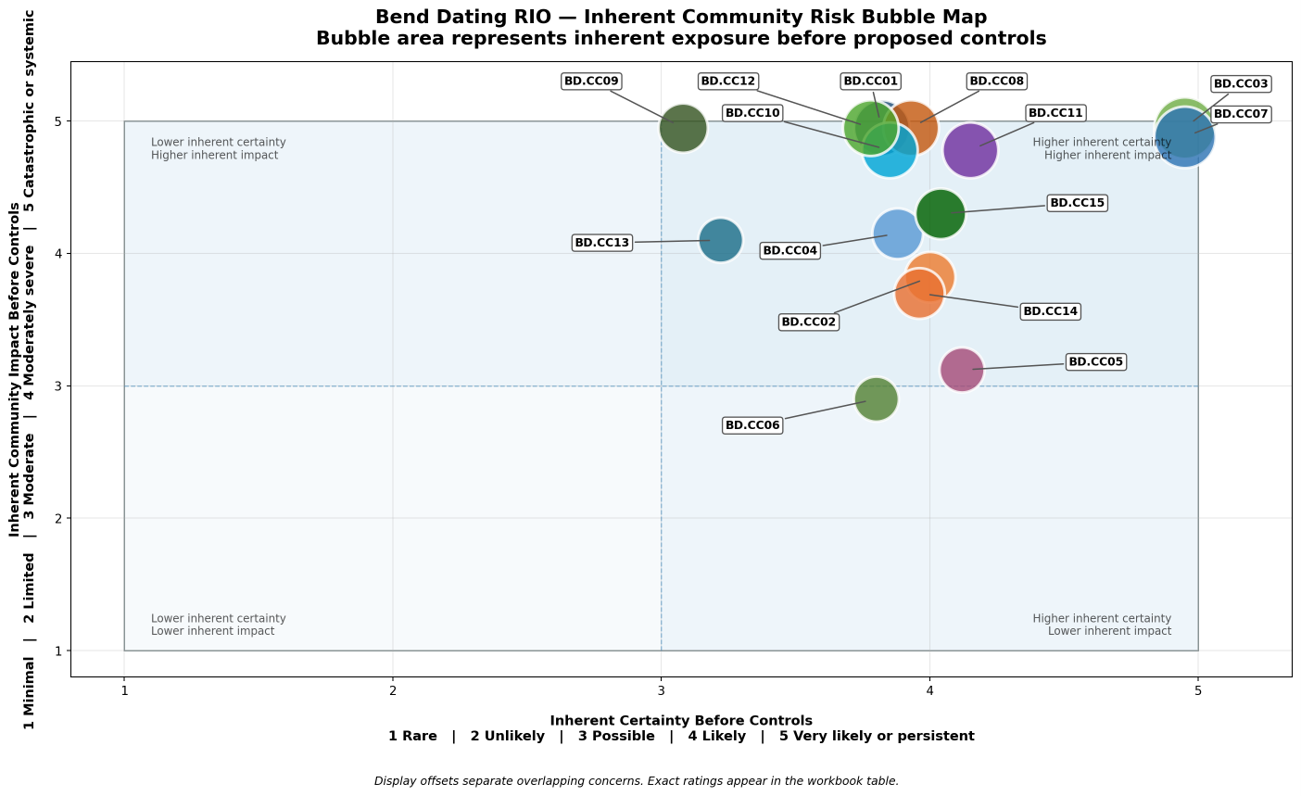
Description of Figure 1. Figure 1, appendix A and appendix B present and define potential Risk impact on concerns. The inherent map shows the level of community and institutional exposure expected before Bend Dating’s proposed controls are applied. In this figure, bubble size represents inherent exposure and is calculated as Inherent Certainty × Inherent Community Impact. The purpose of the inherent map is not to predict which person will commit an act of violence, deception, or fraud. Rather, it provides a structured way to show where the enterprise would be most exposed if the safeguards were absent, weak, or not consistently implemented.
Narrative interpretation of Figure 1. In the current inherent-risk spreadsheet, Identity and Account Integrity (BD.CC03) and Conduct (BD.CC07) are among the largest and highest concerns because each was rated 5 for inherent certainty and 5 for inherent community impact. Reporting (BD.CC08), Enforcement (BD.CC10), Privacy (BD.CC11), Cybersecurity (BD.CC12), and Governance (BD.CC01) also appear as large, high-impact concerns. This means that before the proposed controls are applied, the model assumes that anonymity, weak accountability, inaccessible reporting, inconsistent enforcement, and technical failures can create broad community-level exposure. Member Education (BD.CC06), Relationship Information (BD.CC05), and Professional Referrals (BD.CC13) still matter, but they appear with lower inherent exposure because their current preliminary ratings are lower than the highest-concern group.
Figure 2. Bend Dating RIO: Residual Community Risk Bubble Map
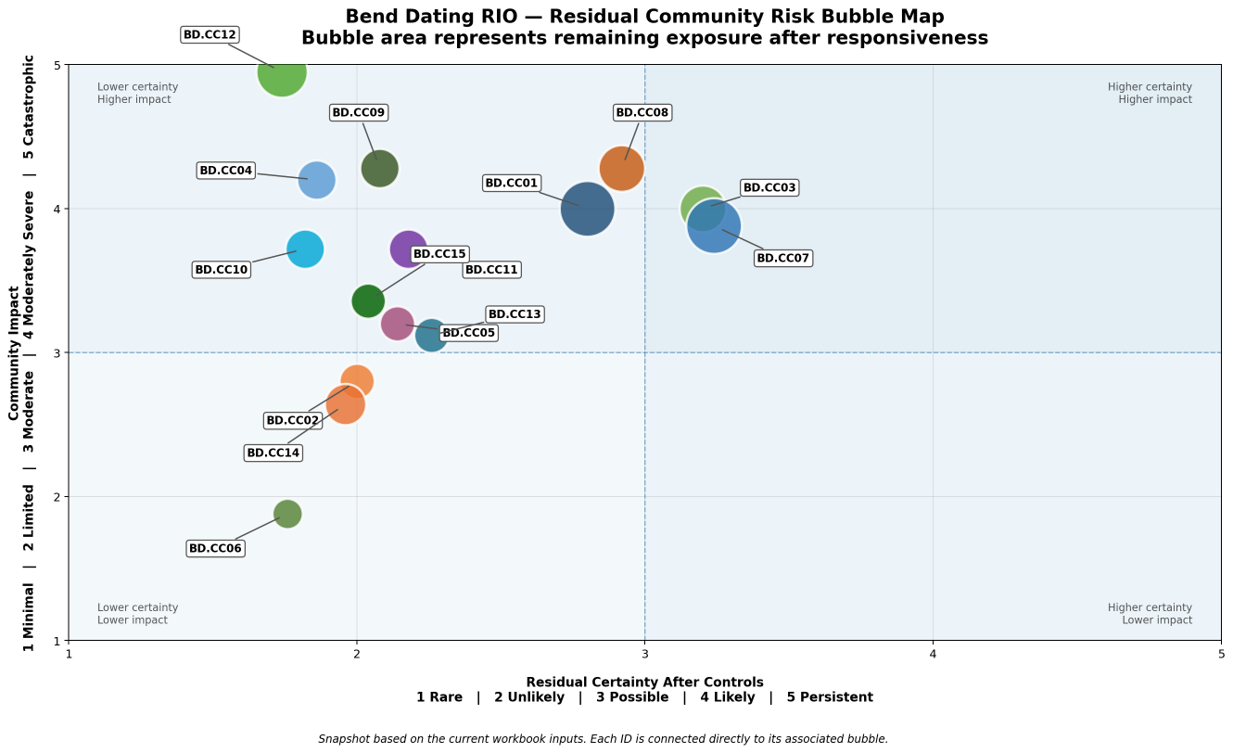
Description of Figure 2. The residual map is a modeled post-control snapshot. It answers the question: after the proposed Bend Dating controls, reporting pathways, and institutional responses are considered, which central concerns still carry the greatest remaining exposure for the Bend community?
Figure 2, appendix A and appendix B present and define the latest residual-risk bubble-map spreadsheet and plots the fifteen central concerns identified as BD.CC01 through BD.CC15; it does not plot the sixteen BD.R Risk Library entries (appendix A). Residual certainty is shown on the horizontal axis from 1 Rare through 5 Very likely or persistent. Community impact is shown on the vertical axis from 1 Minimal through 5 Catastrophic or systemic. Bubble size represents remaining exposure after considering responsiveness and is calculated as Residual Certainty × Community Impact × (6 − Responsiveness). Large bubbles in the upper-right region therefore represent concerns that remain more likely, more consequential, and less fully mitigated. Smaller bubbles clustered in the lower-left region have lower modeled certainty, lower community impact, stronger responsiveness, or some combination of those features.
In the current spreadsheet, Cybersecurity (BD.CC12) appears highest because its community-impact rating is 5. Governance (BD.CC01) and Conduct (BD.CC07) are the largest bubbles because each has a remaining-exposure score of 36. Identity and Account Integrity (BD.CC03) and Reporting (BD.CC08) have medium bubbles with remaining-exposure scores of 24. Member Education (BD.CC06) appears lower and smaller because its current ratings produce a remaining-exposure score of 8. The map therefore does not say that a smaller central concern is unimportant; it says that the modeled remaining exposure is lower after considering residual certainty, community impact, and responsiveness.
The map also illustrates why response speed must not be confused with event velocity. A threatening message, assault, or disclosure can occur immediately. Reporting and enforcement do not slow the original onset. They improve institutional responsiveness by reducing duration, repeat exposure, recurrence, and uncontrolled spread.
Comparative example: identity and account integrity. In the inherent map, BD.CC03 has very high pre-control exposure because the use of false identity, disposable accounts, duplicate accounts, and concealed reentry is modeled as both highly likely and highly consequential when identity-linked accountability is absent. In the residual map, BD.CC03 remains important, but it moves downward because the proposed model adds identity verification, account integrity controls, reporting, and institutional response. The point of the comparison is not that identity-based harm disappears; it is that the enterprise plausibly reduces the certainty and spread of that harm when the controls are functioning.
Comparative example: reporting and community knowledge. In the inherent map, Reporting (BD.CC08) is large because if members cannot report concerns in a trusted and usable way, harmful conduct may remain hidden and repeat. In the residual map, Reporting remains a medium-to-large concern rather than a trivial one. That result is useful because it shows that reporting is not a decorative feature. Even with a reporting system, the institution must still maintain accessibility, trust, timely review, documentation, and meaningful follow-through. The reporting example also illustrates why a community-level model can show substantial improvement while still refusing to guarantee individual safety.
Comparative example: member education and cybersecurity. Member Education (BD.CC06) becomes one of the smaller residual bubbles because the current model assumes that conduct standards, expectations, explanations, and guidance can materially improve member understanding. Cybersecurity (BD.CC12), by contrast, remains relatively large even after the proposed controls are considered because its community impact stays high. A data-security incident can affect many people at once, produce lingering harm, and undermine trust across the enterprise. These examples show that the bubble maps are useful not merely for ranking concerns, but for distinguishing concerns that are readily reduced from concerns that remain consequential even after mitigation.
Taken together, Figures 1 and 2 demonstrate the modeled impact of Bend Dating’s seven-layer control system. Figure 1 establishes the community and institutional exposure expected before the safeguards are applied. Figure 2 shows the exposure expected to remain after the safeguards and responsiveness are taken into account. The comparison makes the Bend Dating model more concrete by showing where the proposed enterprise is expected to reduce certainty, impact, recurrence, or remaining exposure; where substantial concerns remain; and why legitimate assurance depends on consistent implementation rather than rhetoric alone.
Interpretation of the Risk Impacting Objectives (RIO) Bubble Maps
The two objective-based bubble maps extend the analysis in Section 5 from the fifteen central concerns, identified as BD.CC01 through BD.CC15, to the twelve conditions Bend Dating must achieve, identified as BD.O001 through BD.O012. Each objective is informed by the central concerns and Risk Library entries that could prevent it from being achieved. The maps therefore do not replace the central-concern or risk analyses. They provide an additional management view showing where failure to achieve Bend Dating’s objectives could create the greatest remaining community exposure. This is consistent with the RIO method described in the paper: objectives define the conditions the enterprise must establish, risks identify what could prevent those conditions, and controls are evaluated according to whether they prevent, detect, contain, correct, or provide learning from those risks.
Interpretation of Central Concerns Bubble Map
Figure 3
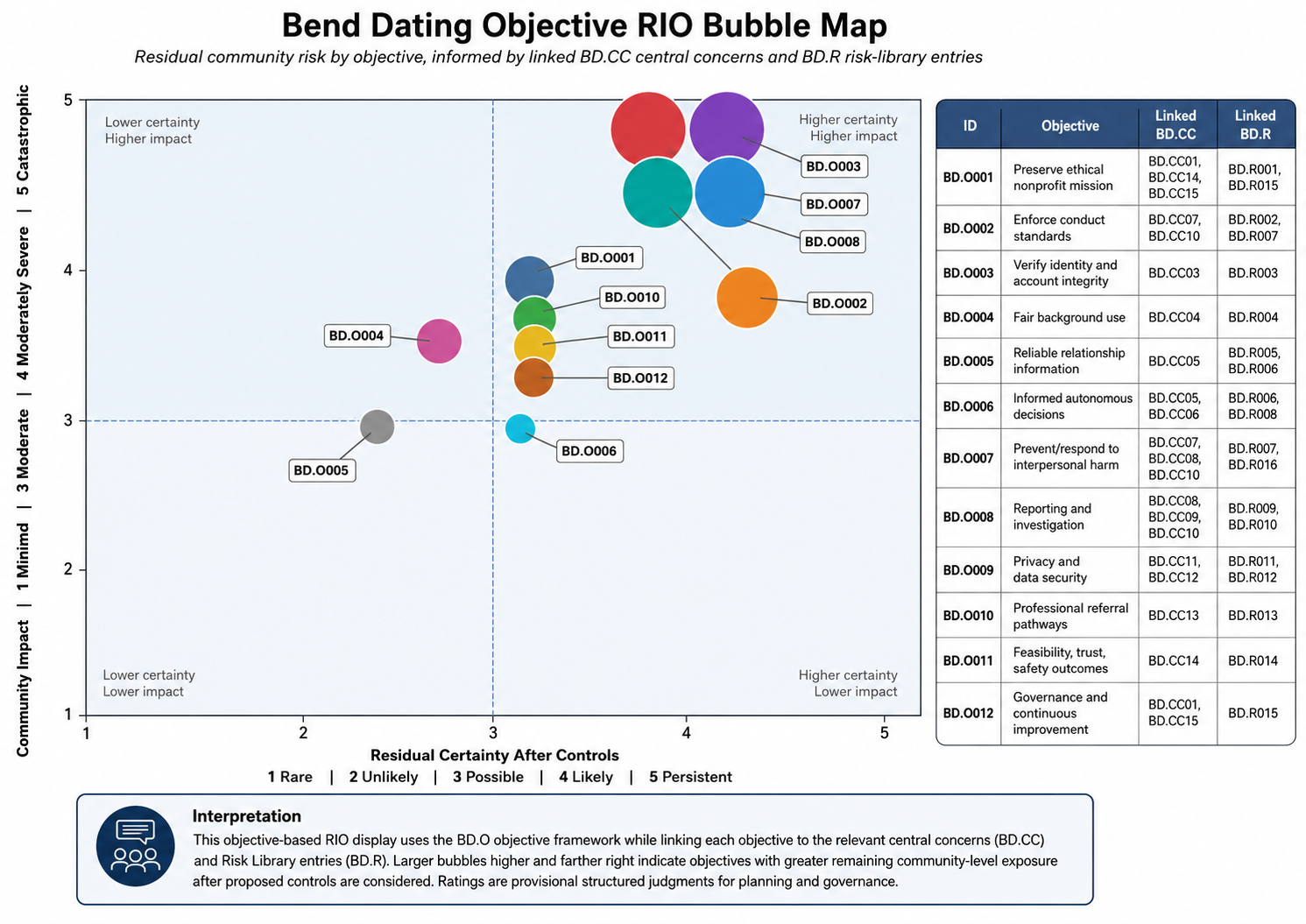
The Figure 3 presents a provisional residual-risk profile for the twelve Bend Dating objectives. Objectives farther to the right have greater expected residual certainty after the proposed controls are considered. Objectives higher on the map have greater potential community impact if they are not achieved. Larger bubbles represent greater remaining exposure. The upper-right concentration therefore identifies the objectives that require the strongest control design, operating evidence, management attention, and Board oversight.
Interpretation of Correctly and Reliably Administered Controls
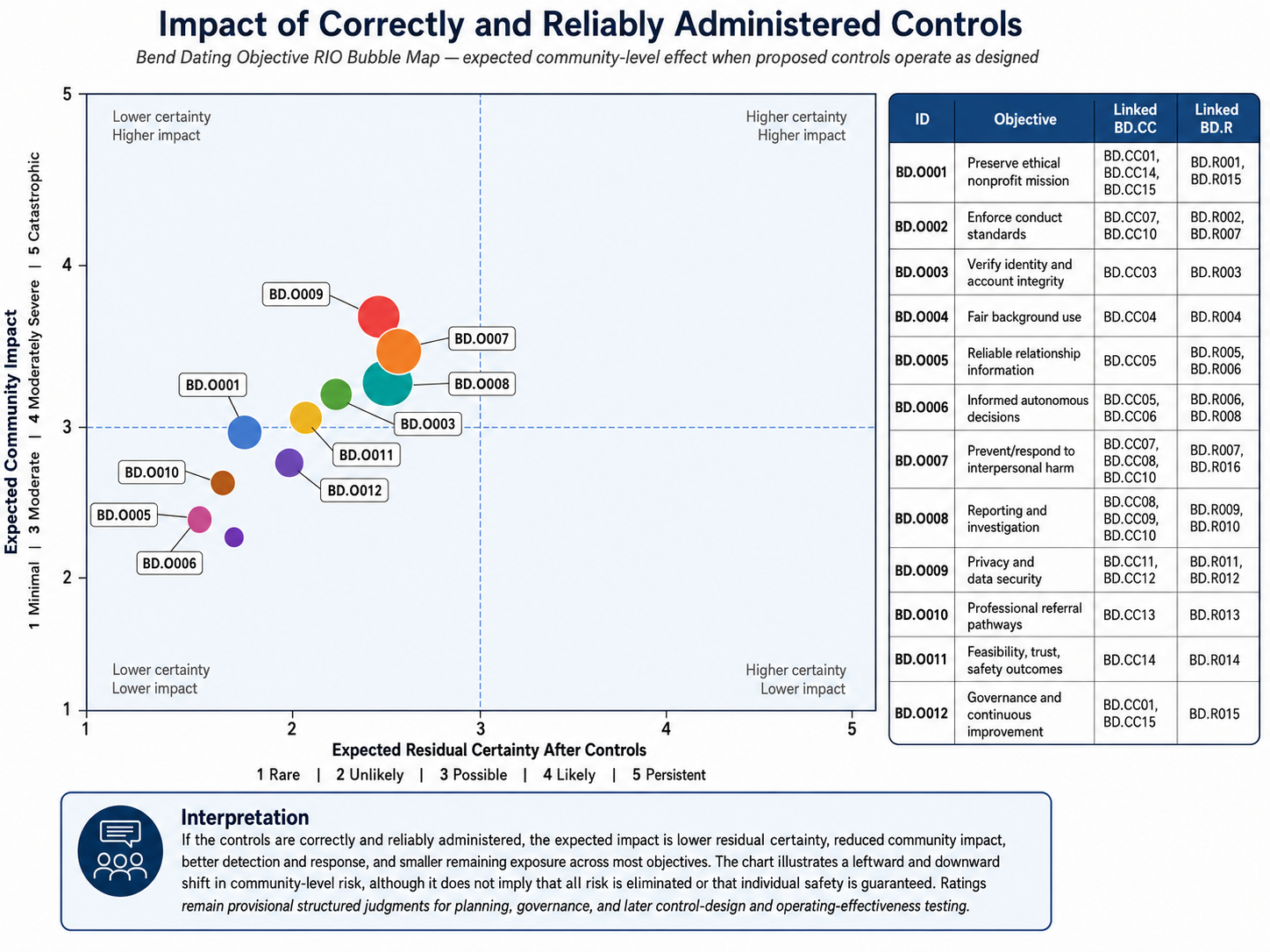
The map in figure 3 indicates that several objectives remain materially important even after the proposed controls are considered. These include:
BD.O003 — Verify identity and account integrity
BD.O007 — Prevent and respond to interpersonal harm
BD.O008 — Provide accessible, fair, and timely reporting and investigation
BD.O009 — Protect privacy and data security
These objectives remain elevated because failures in identity integrity, interpersonal safety, reporting, privacy, or cybersecurity can affect more than one member, permit repeated exposure, undermine confidence in the entire enterprise, and impair Bend Dating’s ability to act on information it receives. Their elevated position does not mean that the controls are ineffective. It means that the consequences of failure remain substantial and that these objectives cannot be treated as routine administrative functions.
Other objectives appear at lower levels of residual certainty or community impact. For example, providing reliable relationship information, supporting informed decisions, and maintaining professional referral pathways may be more readily controlled through defined standards, member explanations, credentialing, scope limitations, and review procedures. A lower position does not mean these objectives are unimportant. It means the current structured judgment projects less remaining community exposure when the proposed controls operate as designed.
The first map should therefore be interpreted as a prioritization map. It identifies where Bend Dating should place the greatest attention before and during the controlled community launch. Objectives with higher or larger bubbles should receive more intensive testing, more visible dashboard measures, clearly assigned control ownership, predefined escalation procedures, and direct Board review.
The second image shows the expected effect if the Bend Dating controls are correctly implemented and reliably administered. Most objectives move leftward, downward, or both. This represents lower residual certainty, reduced community impact, or smaller remaining exposure after the controls and institutional responsiveness are taken into account.
The movement is expected to occur through specific mechanisms rather than through the mere existence of policies:
Entry requirements and identity verification reduce anonymous and disposable participation.
Conduct standards make prohibited behavior and consequences explicit.
Reporting increases the probability that misconduct will become known.
Investigation connects allegations, evidence, and repeated patterns.
Temporary restrictions and protective actions reduce continuing exposure.
Sanctions, expulsion, and reentry prevention reduce recurrence.
Privacy and cybersecurity controls reduce unauthorized access and secondary use.
Measurement and independent review identify failures and require corrective action.
The expected effect is not simply fewer individual incidents. Correct and reliable administration should also reduce the duration of unmanaged risk, the number of additional members exposed after the institution receives warning, the ability of removed members to return, the persistence of undetected patterns, and the likelihood that control failures will continue without correction. The paper already distinguishes the speed with which an event can begin from the institution’s responsiveness after it becomes known: a harmful event may occur immediately, while rapid reporting, restriction, investigation, and enforcement can still reduce recurrence and repeat exposure.
What the comparison demonstrates
Read together, the two images illustrate the difference between control design and control performance.
The first image shows the provisional residual exposure associated with the twelve objectives based on the proposed control structure. The second shows the lower exposure expected when those controls are not only present, but are correctly and consistently performed. The comparison therefore expresses the central assurance proposition of Bend Dating:
Bend Dating becomes safer and more accountable not because it publishes policies or advertises safeguards, but because its controls are implemented, used, documented, tested, corrected, and governed as intended.
This distinction is essential. Identity verification has little protective value if members bypass it or removed members can reenter. Reporting has little value if members cannot find it, do not trust it, or receive no meaningful response. Investigation has little value if evidence is not preserved or comparable cases receive inconsistent decisions. Governance has little value if the Board does not receive reliable performance information or require correction of material failures. The paper expressly recognizes that written policies alone do not establish effectiveness; operating effectiveness requires evidence that verification, reporting, triage, investigation, sanctions, duplicate-account detection, and corrective actions actually occurred as required.
Meaning for the controlled community launch
The maps support proceeding with a controlled Bend community launch because they identify both the intended protective effect and the conditions that must be tested. During the launch, Bend Dating should compare the projected objective ratings with actual operating evidence, including:
Verification completion and failure
Duplicate accounts and reentry attempts
Report accessibility and member confidence
Time to acknowledgment, triage, and protective action
Investigation quality and completion time
Repeat reports and repeat exposure
Sanction consistency and appeals
Privacy and cybersecurity incidents
Corrective-action completion
Staff workload and safety-response capacity
Member trust and informed decision-making
Governance review and stop-rule activation
The objective maps are therefore not proof that Bend Dating has already achieved the projected reductions. They are a testable baseline. If the software, personnel, policies, and governance controls operate reliably, the enterprise should move toward the lower-left region of the second map. If actual data do not support that movement, the ratings must be revised, deficiencies corrected, enrollment limited or paused, and expansion withheld.
Overall conclusion
The two images support a positive but conditional interpretation. Bend Dating’s integrated controls have a reasonable design basis for reducing residual certainty, community impact, recurrence, repeat exposure, and institutional indifference. The greatest benefit should occur when identity-linked participation, credible reporting, timely investigation, meaningful enforcement, privacy protection, measurement, and governance operate together rather than as isolated features.
The maps do not establish that all risk is eliminated, that every member is safe, or that no serious event will occur. They demonstrate something more credible and operationally useful: the objectives can be identified, the risks to those objectives can be mapped, the expected effect of the controls can be stated, and actual performance can later be tested against that expectation. That is the basis for legitimate assurance and the reason Bend Dating’s safety claim is more than a promise.
6. Reliability, Validity, and Usefulness
6.1 Reliability
Reliability is supported by stable identifiers, controlled definitions, common rating criteria, source references, and explicit mappings. Risk identifiers BD.R001 through BD.R016 should remain consistent across the Risk Library, Risk Control Matrix, Risk Evaluation, and Appendix A. Central-concern identifiers BD.CC01 through BD.CC15 should remain consistent across the central-concern definitions, Bubble Map Input, chart labels, concern key, and bubble-map interpretation.
6.2 Validity
The seven-layer model has strong preliminary content validity because it covers the principal institutional, behavioral, informational, professional, and community domains relevant to safer dating. It has convergent and corroborative validity because its mechanisms correspond with independent findings concerning protective environments, deterrence, collective efficacy, consent education, identity attribution, reporting accessibility, repeat-offender detection, and victim-centered response. Concurrent validity can be tested by examining contemporaneous correlations between implementation strength and member safety, trust, reporting confidence, perceived accountability, and response effectiveness. Discriminant or divergent evidence can further show that the framework is associated with accountability and protection rather than unrelated demographic, political, educational, or ordinary personality characteristics.
6.3 Usefulness
The RIO is useful because it converts safety claims into testable requirements. It can identify uncovered risks, redundant controls, weak ownership, missing evidence, overdue corrective action, and residual risks that require acceptance, additional treatment, or public qualification. It also creates a baseline against which actual reporting, response, repeat-offender, and community-outcome data can later be compared.
6.4 Comparative Best-in-Class Assessment
A comparison of publicly described safety systems shows that major dating platforms have adopted meaningful individual safeguards. Tinder describes photo verification, blocking, reporting, automated and manual moderation, message-intervention prompts, and safety resources. Bumble describes photo and optional government-ID verification, reporting and blocking, explicit-image detection, scam detection, date sharing, and survivor-support partnerships. Hinge describes moderation, anonymous reporting, safety-specialist escalation, and post-date feedback. Match Group describes automated and manual review, video-selfie verification, safety education, centralized safety information, and cross-brand review of serious violations. [21, 22, 23, 24]
These systems establish an important industry baseline. Bend Dating’s claim to best-in-class status rests on the additional integration shown below.
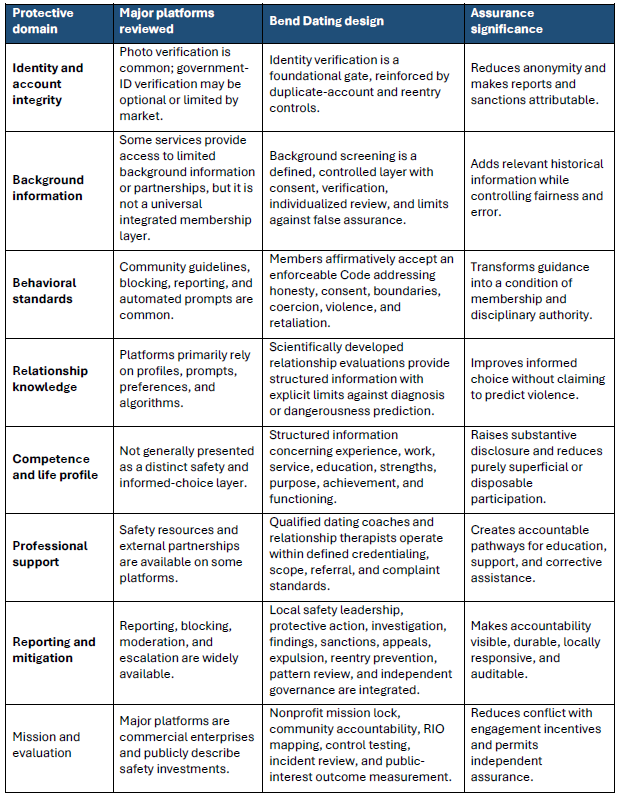
The comparison does not establish that competing platforms have no internal controls beyond their public descriptions. It establishes that the complete Bend Dating architecture is not evident in the public materials reviewed. Accordingly, the proper claim is: Bend Dating is designed to provide a best-in-class level of legitimate assurance among the reviewed dating platforms because it combines and audits protective layers that competitors generally present separately, optionally, or not at all.
7. Limitations
The residual ratings are provisional design-assurance conclusions that must be confirmed through implementation and operating evidence.
No Bend Dating incident history or longitudinal outcome data were available.
External prevalence findings should not be treated as direct estimates of Bend Dating incidence.
Underreporting may make low complaint volume appear safer than the actual environment.
Identity and background screening are not certificates of individual safety; their value lies in gatekeeping, attribution, informed choice, enforcement, pattern detection, and reentry prevention.
Events may occur after members move offline and outside Bend Dating’s immediate control.
Community ratings do not diminish the severity of harm experienced by an individual victim or survivor.
8. Recommended Implementation and Testing
Control ownership and evidence: Approve named owners, required records, frequency, escalation criteria, and evidence retention for all material controls.
Serious-incident protocol: Adopt a separate sexual assault, stalking, coercive-control, and dating-violence response procedure, including temporary restrictions, evidence preservation, confidentiality, trauma-informed communication, referral, expulsion, and reentry prevention.
Reporting accessibility: Test whether a member can recognize a violation, find the reporting function, submit information safely, and understand what happens next.
Timeliness: Measure time from report to acknowledgment, risk triage, protective action, investigation, decision, and closure.
Pattern detection: Measure repeat reports, repeat victimization, repeat-offender indicators, reentry attempts, and whether separate reports are linked.
Fairness: Review sanction consistency, background-screening corrections, investigation quality, appeals, reversals, and disparities in outcomes.
Community outcomes: Track member trust, perceived safety, willingness to report, withdrawal due to safety concerns, meaningful interactions, in-person meetings, relationship formation, and appropriate departure from the app.
Fidelity before outcome judgment: Measure whether every layer was implemented as designed before concluding that the seven-layer theory succeeded or failed. A negative outcome should not be attributed to the model when identity verification, reporting, investigation, enforcement, reentry prevention, staffing, or member education was inconsistently performed.
Mechanism testing: Measure whether the proposed mechanisms actually changed: entry abandonment at each gate, perceived certainty of accountability, understanding of sanctions, reporting confidence, time to report, pattern linkage, response time, repeat exposure, and attempted reentry.
Balanced hypotheses: Predefine protective, null, and adverse-effect hypotheses. The evaluation should be capable of finding that the seven layers reduced risk, made no material difference, or created unintended burdens. This protects the RIO from both positive and negative confirmation bias.
Low-base-rate safeguards: Do not use the seven layers as an actuarial score predicting which individual will commit serious violence. Where any screening classification is evaluated, report the outcome base rate, sensitivity, specificity, positive predictive value, negative predictive value, false-positive and false-negative counts, calibration, observation period, and decision threshold.
Decision-specific thresholds: Use different evidentiary thresholds for education, additional monitoring, temporary protective restriction, suspension, warning, expulsion, and emergency referral. Low-confidence information may justify support or review but should not automatically produce permanent exclusion.
Validity testing: Evaluate content validity, convergent and corroborative validity, concurrent associations with safety and trust measures, and divergent or discriminant relationships with unrelated characteristics. Examine the seven layers both individually and as an interacting protective system.
Best-in-class assurance review: Periodically compare Bend Dating’s publicly documented controls with major dating platforms and relevant prevention standards. The best-in-class claim should remain limited to the comprehensiveness, integration, governance, and testability of the design among the systems reviewed.
Independent review: Require periodic independent testing of design and operating effectiveness and governance review of all serious safety incidents and overdue high-risk corrective actions.
9. Conclusion
The Bend Dating RIO provides a coherent, source-supported basis for legitimate assurance. It demonstrates that the enterprise is not relying on slogans, optional tips, or a single verification feature. It is establishing a controlled community in which entry, identity, information, conduct, support, reporting, sanctions, governance, and improvement are linked. The seven layers collectively close access to people unwilling to accept identification and accountability, raise the expected cost of misconduct, increase the probability that repeated behavior will be detected, and enable durable removal and prevention of reentry.
Among the major dating platforms reviewed, no public safety description showed the same complete, locally accountable, nonprofit, seven-layer system with formal RIO mapping and control testing. Bend Dating may therefore reasonably describe its proposed design as best-in-class among the reviewed platforms. This is a claim of comparative design assurance, not a guarantee that no harmful event will occur. Its credibility depends on fidelity: the controls must be funded, consistently implemented, supported by trained personnel, independently reviewed, and corrected when they fail.
The appropriate conclusion is not to give up because individual violence cannot be predicted perfectly. Low base rates make individual prediction an unsuitable foundation for membership decisions. The stronger scientific strategy is to reduce anonymity, opportunity, recurrence, repeat exposure, and institutional indifference. The RIO is the mechanism that allows Bend Dating to demonstrate whether its best-in-class protective design becomes best-in-class performance.
Appendix A. Risk Results (BD.R001–BD.R016)
Download and See Appendix A Table (BD.R001–BD.R016).
Download and See Appendix B Table (BD.CC001–BD.CC015)
References
A. Bend Dating Design and Policy Authorities
[1] Mentor Research Institute. Before Asking Bend to Trust Bend Dating.
Source: https://www.mentorresearch.org/before-asking-bend-to-trust-bend-dating
Relevant contribution: Establishes the project’s institutional-accountability premise: Bend Dating should not be trusted merely because its safeguards sound credible. It supports independent oversight, defined controls, testing, transparent limitations, and corrective action as conditions of legitimate assurance.
[2] Mentor Research Institute. Why Bend Dating Was Created: A Local Answer to a Loveless Dating Economy.
Source: https://www.mentorresearch.org/why-bend-dating-was-created-a-local-answer-to-a-loveless-dating-economy
|Relevant contribution: Defines the nonprofit, local-community, and relationship-outcome mission. It explains why Bend Dating rejects engagement-maximization incentives and instead measures success through safer participation, informed choice, meaningful relationships, and appropriate departure from the platform.
[3] Mentor Research Institute. Assessing Public Interest in a Safer, More Accountable, Relationship-Outcome-Oriented Gen3 Dating App.
Source: https://www.mentorresearch.org/assessing-public-interest-in-a-safer-more-accountable-relationship-outcome-oriented-gen3-dating-app
Relevant contribution: Supplies the proposed feasibility and public-interest research framework. It supports measuring acceptance, participation, trust, safeguards, meaningful interaction, relationship outcomes, and whether a community will support a more demanding accountability model.
[4] Mentor Research Institute. Bend Dating: Member and Public Safety Policy.
Source: https://www.mentorresearch.org/bend-dating-public-and-member-safety-policy
Relevant contribution: Serves as the primary operational authority for eligibility, identity verification, screening, reporting, protective action, investigation, sanctions, appeals, privacy, safety governance, and continuous improvement. It is the principal source for translating the seven layers into auditable controls.
[5] Mentor Research Institute. Bend Dating: Safety, Trust, Accountability.
Source: https://www.mentorresearch.org/bend-dating-safety-trust-accountability
Relevant contribution: Explains how identity, background information, relationship knowledge, privacy, safety leadership, and institutional accountability work together to create trust. It supports the RIO’s integrated-control theory rather than reliance on a single safety feature.
B. Independent Research, Public-Health, Risk-Management, and Governance Sources
[6] Pew Research Center. From Looking for Love to Swiping the Field: Online Dating in the U.S. 2023.
Source: https://www.pewresearch.org/internet/2023/02/02/from-looking-for-love-to-swiping-the-field-online-dating-in-the-u-s/
Relevant contribution: Provides national evidence that online dating produces both relationships and substantial safety concerns, including unwanted sexual messages, repeated contact after disinterest, insults, threats, and public unease about meeting app users. It supports treating harassment, safety perception, trust, and screening expectations as material RIO concerns.
[7] Federal Trade Commission. What To Know About Romance Scams.
Source: https://consumer.ftc.gov/articles/what-know-about-romance-scams
Relevant contribution: Describes recurring romance-scam methods: false identities, rapid emotional escalation, movement off-platform, requests for money, and hard-to-reverse payments. It directly supports the RIO risks and controls concerning identity integrity, fraud education, reporting, and rapid protective action.
[8] Centers for Disease Control and Prevention. Risk and Protective Factors: Sexual Violence Prevention. 2024.
Source: https://www.cdc.gov/sexual-violence/risk-factors/index.html
Relevant contribution: Frames sexual violence as the product of individual, relationship, community, and societal conditions. Its identification of weak institutional support, permissive norms, and weak sanctions as risk factors supports Bend Dating’s emphasis on institutional responsibility, enforceable standards, protective environments, and community accountability.
[9] Centers for Disease Control and Prevention. Preventing Sexual Violence. 2024.
Source: https://www.cdc.gov/sexual-violence/prevention/index.html
Relevant contribution: Identifies complementary prevention strategies involving protective social norms, healthy relationship skills, protective environments, consistently applied policies, monitoring, and victim-centered services. These strategies converge with the seven-layer design and support evaluating the layers as a coordinated prevention system.
[10] Wolbers H, Boxall H, Long C, Gunnoo A. Sexual Harassment, Aggression and Violence Victimisation Among Mobile Dating App and Website Users in Australia. Australian Institute of Criminology, Research Report 25. 2022.
Source: https://www.aic.gov.au/publications/rr/rr25
Relevant contribution: Provides direct empirical evidence of online and in-person dating-app-facilitated harassment, stalking, coercion, sexual assault, and repeat victimization. It supports separating serious sexual and dating violence from lower-level misconduct and emphasizes prevention of both initial occurrence and recurrence.
[11] Centers for Disease Control and Prevention. Sexual Violence Prevention Resource for Action.
Source: https://www.cdc.gov/violence-prevention/media/pdf/resources-for-action/SV-Prevention-Resource_508.pdf
Relevant contribution: Compiles evidence-informed strategies across the social ecology and emphasizes that prevention works best through coordinated norms, skills, protective environments, survivor support, monitoring, and evaluation. It supports the RIO’s layered-control structure and the requirement to test implementation fidelity and outcomes.
[12] World Health Organization and London School of Hygiene and Tropical Medicine. Preventing Intimate Partner and Sexual Violence Against Women: Taking Action and Generating Evidence. 2010.
Source: https://www.who.int/publications/i/item/9789241564007
Relevant contribution: Treats intimate-partner and sexual violence as preventable public-health problems requiring primary prevention, multilevel action, coordinated services, and evidence generation. It supports Bend Dating’s community-level unit of analysis and prospective evaluation rather than placing responsibility solely on individuals.
[13] National Institute of Standards and Technology. Cybersecurity Framework 2.0.
Source: https://www.nist.gov/cyberframework
Relevant contribution: Provides the authoritative Govern, Identify, Protect, Detect, Respond, and Recover structure for cybersecurity risk management. It supports controls governing identity, screening, incident, and profile data; access management; logging; vendor oversight; incident response; and service continuity.
[14] National Institute of Standards and Technology. Privacy Framework.
Source: https://www.nist.gov/privacy-framework
Relevant contribution: Provides a structured method for identifying and managing privacy risk throughout collection, use, access, retention, disclosure, and disposal. It is directly relevant because Bend Dating proposes to hold sensitive identity, screening, relationship, and safety-report information.
[15] Deloitte. Data and Digital Trust.
Source: https://www.deloitte.com/us/en/services/consulting/services/data-and-digital-trust.html
Relevant contribution: Explains digital trust as an outcome of governance, trusted identity, privacy, security, responsible data use, and transparent practices. It supports the RIO conclusion that safety assurance depends on accountable technology and information governance, not merely screening members.
[16] National Institute of Justice. Five Things About Deterrence.
Source: https://nij.ojp.gov/topics/articles/five-things-about-deterrence
Relevant contribution: Summarizes the central deterrence finding that perceived certainty of detection generally matters more than increasing punishment severity. It supports treating verified identity, visible reporting, consistent investigation, sanctions, and reentry prevention as preventive as well as responsive controls.
[17] Office of Justice Programs. Focused Deterrence of High-Risk Individuals.
Source: https://popcenter.asu.edu/sites/g/files/litvpz3631/files/spi_focused_deterrence_pop_guide_final.pdf
Relevant contribution: Supports clear communication of prohibited behavior and consequences, concentrated attention to identified risk, predictable monitoring, and reliable follow-through. It strengthens the rationale for warnings, enhanced monitoring, expulsion, repeat-pattern review, and reentry prevention.
[18] Pew Research Center. More Than Twice as Many Americans Support Than Oppose the #MeToo Movement. 2022.
Source: https://www.pewresearch.org/social-trends/2022/09/29/more-than-twice-as-many-americans-support-than-oppose-the-metoo-movement/
Relevant contribution: Documents changed social expectations concerning sexual misconduct, including greater perceived accountability and greater likelihood that people reporting misconduct will be believed. It supports treating post-#MeToo norms as a contextual protective factor that may increase reporting legitimacy and deterrence.
[19] National Institute of Justice. Neighborhood Collective Efficacy: Does It Help Reduce Violence?
Source: https://www.ojp.gov/pdffiles1/nij/184377NCJRS.pdf
Relevant contribution: Defines collective efficacy as social cohesion and mutual trust combined with willingness to intervene for the common good, and associates stronger collective efficacy with lower violence. It provides theoretical support for Bend Dating’s bounded-community, shared-standards, and community-accountability model.
[20] National Institute of Justice. Collective Efficacy: Taking Action to Improve Neighborhoods.
Source: https://www.ojp.gov/pdffiles1/nij/249823.pdf
Relevant contribution: Describes how communities reinforce acceptable behavior through shared expectations, informal social control, local institutions, and coordinated action. It supports the proposition that membership, reputation, reporting, and loss of access can have greater meaning in a locally governed community.
C. Dating-Platform Comparator Sources
[21] Tinder. Safety and Policy Center; Safety Features. Accessed August 2026.
Source: https://tinder.com/safety-and-policy/intl/en/ and https://policies.tinder.com/community-resources/safety-features/intl/en/
Relevant contribution: Documents Tinder’s publicly described verification, automated and human moderation, reporting, banning, cross-brand review, blocking, safety prompts, fraud controls, and education. It provides a fair comparator and prevents the paper from understating existing industry safeguards.
[22] Bumble. Safety Centre. Accessed August 2026.
Source: https://safety.bumble.com/en_US
Relevant contribution: Documents Bumble’s publicly described photo and identity verification, message-review prompts, explicit-image protection, scam detection, in-app communication, date sharing, reporting, blocking, education, and survivor-support resources. It is used to compare the breadth and integration of Bend Dating’s proposed controls.
[23] Hinge. Trust & Safety. Accessed August 2026.
Source: https://hinge.co/trustandsafety
Relevant contribution: Describes Hinge’s values-based expectations, automated and human moderation, reporting, specialist escalation, education, and post-date “We Met” feedback. It is especially relevant to Bend Dating’s reporting, offline-incident awareness, and learning-after-contact controls.
[24] Match Group. Safety: Our Commitment and Approach. Accessed August 2026.|
Source: https://mtch.com/safety/
Relevant contribution: Describes portfolio-level safety technology, moderation, verification, centralized cross-brand records, blocking, background-information access, customer care, partnerships, and offender exclusion. It is the strongest industry governance comparator for evaluating Bend Dating’s best-in-class design claim.