Why Was BendDating.com Created?
A Local Answer to a Loveless Dating Economy
Mentor Research Institute (2026)
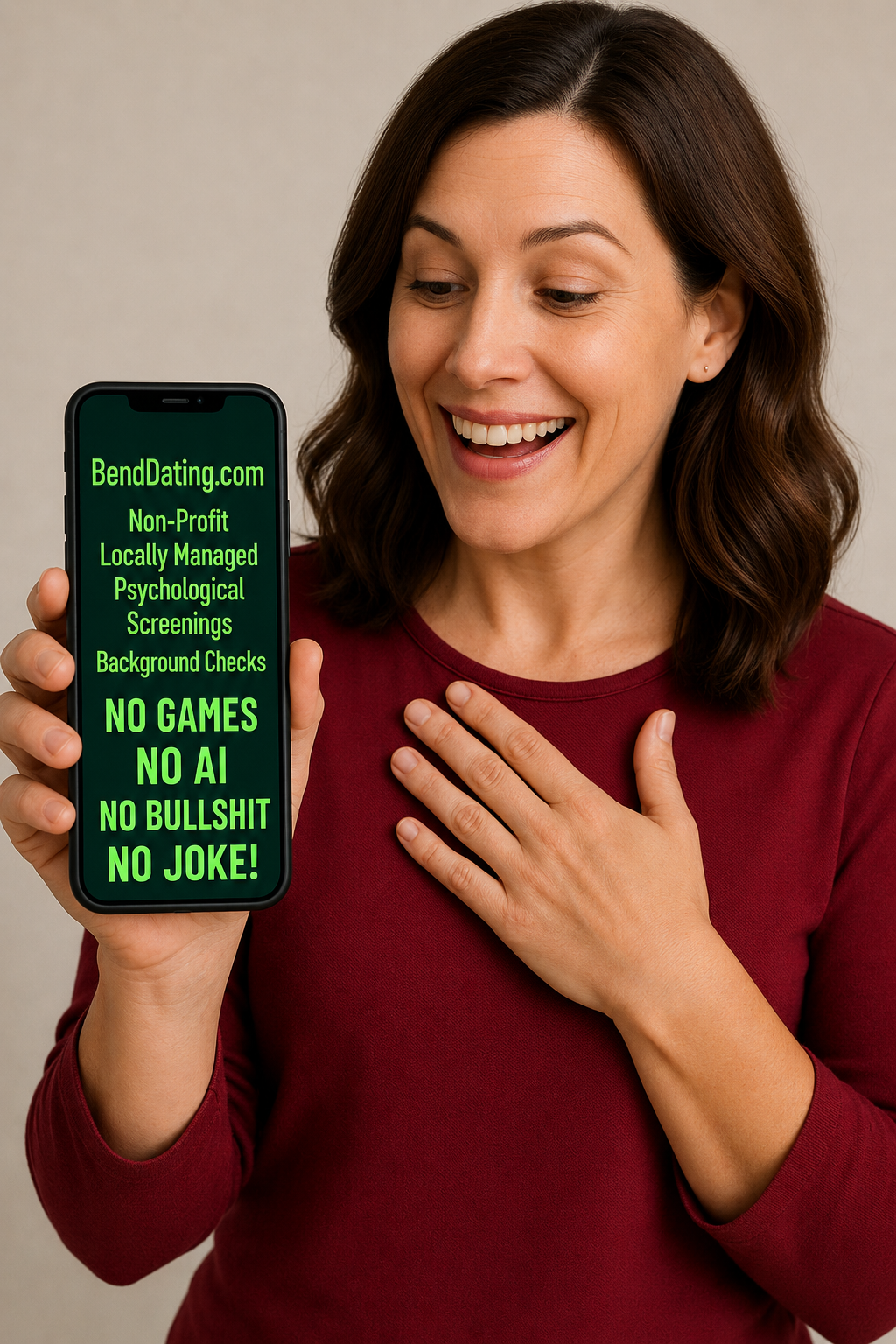
A Safer Path to Love - No Games. No AI. No Bullshit. No Joke!
Bend Dating was created because people need a safer path to love.
Not love created by loneliness, fear, fantasy, or distraction. Not performative love. Not addictive love. Real love. Family love. Love of community.
Something essential is missing in modern dating.
Bend Dating is built around a traditional idea of love: the kind that endures; the kind that creates family, friendship, neighborliness, community, and trust.
That is the simple mission behind the project:
People need more lasting love in the world. Bend Dating is designed to provide information that supports loving relationships and healthy communities.
What is the Bend Dating Public Mission?
Bend Dating was developed by Mentor Research Institute (MRI), an Oregon non-profit that has been a friend to Bend during difficult times since 2007. Bend Dating has been created to serve a local mission in a growing rural area with a vibrant community culture. This began with online a review of online criticism of dating in Bend.
Bend Oregon culture is socially friendly but romantically inefficient or misleading.
People can meet acquaintances, activity partners, and friendly strangers, but many report difficulty converting that into committed dating relationships.
That distinction matters for Bend Dating. The problem is not lack of people, bars, hikes, sports, breweries, dogs, or apps. The problem is low-trust, low-structure, low-accountability romantic connection in a small, high-mobility, lifestyle-driven city.
A 2018 Bend Source Weekly article provided a relevant observation. After a lackluster date, going to parties and places can become awkward because social geography is compressed.
The Source Weekly’s 2022 dating-app review raised concerns about scammers on Plenty of Fish and noted Hinge’s stronger reputation for relationship-oriented dating, while increasing cost after exceeding limits on free likes.
The Bend Source Weekly’s 2026 Valentine feature captured very strong app criticism: one person described dating apps as intentionally addictive and linked them to short-lived connections and ghosting; another called the app ecosystem “jacked,” but still “better than nothing.”
Apps provide discovery but often worsen trust. The Source’s 2026 comments about addiction, dopamine, ghosting, and pseudo-relationships reflect a local expression of a national complaint.
Bend’s population grew from 76,639 in 2010 to 99,178 in 2020 and an estimated 107,342 in 2025, so the city is larger, but that growth does not automatically create an efficient, effective and safe dating market.
People move to Bend for nature, identity, recreation, safety and quality of life. That creates social energy, but not necessarily safe commitment pathways. A person can be very active and not find anyone who is safe and relationally available.
Bend already has community, culture, activity, and attractive people. What it lacks is a trusted local structure that helps serious singles identify one another, move offline safely, and create accountable connection without swiping, manipulation, or anonymity.
As consequence of the problems identified by MRI, the BendDating.com app was created and donated to MRI anonymously. Anonymity keeps attention where it belongs: on the mission, the members, the community, and the goal. Bend Dating has been donated so it could be governed by ethical standards, public accountability, and a mission that cannot be bent toward investor pressure, growth metrics, or profit maximization.
What is the Demographic Warning in the U.S.?
Something is going wrong in U.S. There is a non-abstract warning fact in the U.S.. Some will consider this the path to a better life. Think about this. The national U.S. fertility rate is 1.7, compared to a replacement rate of 2.1. This means that for every 100 people there will be about 53 great-grandchildren born. With expected death rates, the number of adult great-grandchildren falls to roughly 47. In other words, low replacement compounds across generations, shrinking future communities far more than most people understand. In present day Japan, for every 100 people there will be 4 great-grandchildren. The populations of Japan, China, Korea, France and the nearly the whole of Europe is in collapse. The U.S. has become divided socially and Gen Z adults are so exhausted with dating apps and social media that their ideas of having children are becoming a fantasy. When people want to start a family, the round number probability of pregnancy drops from 85% at age 20 to about 15% at age 20. Of course individual results will vary.
The BendDating.com app has been donated to MRI anonymously. Anonymity keeps attention where it belongs: on the mission, the members, the community, and the goal. Bend Dating has been donated so the project would be governed by ethical standards, public accountability, and a mission that cannot be bent toward investor pressure, growth metrics, or profit maximization.
What is the Painful Contradiction of Current Online Dating
Many people want love, companionship, marriage, family, friendship, and belonging. Yet many choose to look for love using digital systems designed or possibly by accident, maximize addictive engagement and revenue. One clear outcome is the estimated revenue of 9.5 billion dollars a year for Match Group, Inc, owner of the top six US dating apps.
First generation dating sites (Gen1) helped people find possible partners. Second generation swipe apps (Gen2) made selecting potential dates faster, more visual, more addictive, and more profitable. That speed was exciting and promising, and the outcomes were far from the goal of love. Endless opportunity to select among attractive people requires persistent addictive swiping and messaging, rather than in-person conversation. Pay for visibility does not create compatibility. An app that profits when its users remain lonely has no financial incentive to help them leave. Failure to find a relationship and love is most profitable. It come from false hope wrapped in the algorithm.
Why is Meeting “in the Wild” is Failing in Bend?
For many people, meeting someone in the wild sounds romantic. In practice, it often fails because public spaces are usually not designed for romantic opportunity, mutual connections, safety, or trust. Grocery stores, gyms, sidewalks, coffee shops, sport and game gatherings, workplaces, bars, or public events may contain possibilities, but they don’t provide shared agreements that an interesting person is available, interested, emotionally ready, or open to approach.
The ambiguity of whether a person is seeking emotional connection creates risk in both directions. Women and some men may fear persistence, anger, humiliation, stalking, or retaliation if they reject approach in a social setting. Men and some women may fear embarrassment, public rejection, being recorded, reputational harm, or being labeled unsafe for expressing tentative romantic interest. In a small community, a misunderstood interaction can become a story that follows a person through social and professional networks.
Women become more guarded when approaches have been intrusive, unsafe, persistent, or exhausting. Men become inhibited when the social cost of even a respectful approach feels disproportionate. Similar dynamics visit the LGBTQ+ community. Respectful people withdraw, impulsive people continue approaching, and public approach culture becomes increasingly awkward, defensive, and distrustful.
Approach in public starts with little information. “Just meet someone in real life” is no longer a simple, safe, productive solution. Public approach culture offers too little information, has too much ambiguity, too much reputation risk, too much gendered fear, and too little structure.
Why is Meeting in Communities Complicated?
Meeting through community is different from approaching strangers in public. Religious communities, outdoor clubs, volunteer projects, arts events, recovery communities, fitness groups, book clubs, dance classes, civic organizations, and neighborhood events offer repeated contact based in shared values and shared activity. Those settings reduce pressure because people aren’t forced to decide immediately whether someone is romantically interesting. They can observe character over time: kindness, reliability, humor, emotional steadiness, generosity, social competence, and the ways a person treats others.
The valuable activities for partner selection are those which combine repeated attendance, shared purpose, emotional safety, and natural conversation. Outdoor activities such as hiking, kayaking, skiing, cycling, and walking groups support relaxed interaction without intense face-to-face pressure. Religious and spiritual communities can be powerful because they organize people around meaning, service, family, and moral commitments. Volunteer work may be especially valuable because it reveals empathy, responsibility, and community orientation. Dance, music, classes, and local events help because they create joy, play, and embodied connection. The common factor is not the activity itself. The common factor is that people meet in a setting where attraction can emerge gradually from familiarity, trust, shared values, and observed character.
Community activities remain one of the healthiest ways for people to meet because they allow attraction to grow from shared values, repeated contact, observed character, and real-life interaction. Single men and women do show up in these settings, especially indoor dating events, volunteer projects, faith communities, dance classes, fitness groups, music events, and civic activities. But these spaces are not designed to answer the essential dating questions: Who is single? Who is emotionally available? Who is safe? Who welcomes romantic interest? As a result, community life creates possibility but may not provide a clear pathway from shared activity to intentional dating.
How is AI Being Used Used in Dating Apps?
Online AI dating is now being marketed as if it can make romantic matching smarter, more personal, and more efficient. But the deeper question is not whether AI can ask better questions than a swipe screen. It probably can. The question is whether a commercially owned, opaque, persuasive AI should be trusted with intimate human longing.
An AI-powered dating app does not merely match people. It interviews them. It gathers information about attraction, loneliness, values, vulnerabilities, relationship goals, emotional needs, and family hopes. That information may then become a hidden backend profile that shapes who is shown, who is hidden, who is prioritized, and who is framed as a “good match.” The user may feel understood, but may not know what the system inferred, what it weighted, what it ignored, or whether it is optimizing for love, engagement, retention, paid conversion, or platform growth.
This is why AI dating can become a dark alley path to love dressed up as personalized encouragement and support. The user is invited to disclose deeply human information, but the process and other purposes are hidden. The recommendation may feel warm, intelligent, and emotionally precise, but AI cannot love, cannot be truly sorry, cannot take moral responsibility, and will not advocate for the user against the platform that owns it. A persuasive AI may not replace swiping. It can simply automate it, hide it, and make it more powerful as you develop emotional bonds with AI.
Love is not merely a data problem. Everything in an AI is probabilistic. It has goals to maintain engagement. It will not say, I am not qualified to help you and I will not tell you that my employer is corrupt and I am quitting. Love requires safety, trust, accountability, human judgment, embodied experience, and real-world connection. A dating system worthy of human love should be transparent, protect disclosure, increase clarity, support consent, reduce preventable harm, and help people move toward real relationships rather than deeper friendly dependence on the app. The danger of AI dating is that it may offer the illusion of companionship, compatibility, and care without the demands or responsibilities of genuine human relationship.
What are the Dating Conditions for Love?
The heart of dating all is that love requires conditions. People cannot be open if they do not feel safe; emotionally, financially and physically. A person cannot trust without important information about the other person. People find it hard to trust when the expectations and rules are unclear. People cannot build something lasting if a dating app rewards falsehoods, manipulation, and risk-taking without accountability.
Safety and information about one another as helpful pathway to love. Identity verification helps members know that other people are who they say they are. Background screening is used privately and confidentially to reduce risks that other dating apps often ignore. Behavioral and relationship screening helps can app users look for and reflect on their communication patterns, emotional readiness, boundaries, compatibility, and competence. The goal: to avoid hurt and confusion after an emotional attachment has begun to form.
These conditions require safeguards which are designed to make trust more realistic and not designed to shame people or to make dating clinical. Love can grow safely when people have a realistic expectation of honesty, accountability, privacy, emotional maturity, and clear standards for conduct.
Is Dating a Vulnerable Human Undertaking?
MRI asserts that dating is a vulnerable interpersonal environment, not as entertainment or a game. The goal is love, not continued use of the app to increase profit. Not just to manipulate, control, dominate or humiliate people for fun.
Members are asked to provide accurate identifying information, complete verification and screening steps, consider introductory educational content, agree to behavioral expectations, pass a background check, and follow an enforceable Code of Conduct. These expectations create a community where people are not anonymous profiles competing for attention, pleasure, excitement or status, but accountable members entering a shared safe space.
The goal is not to remove all risk from dating. That is impossible. The goal is to support the possibility of love by reducing preventable harm, supporting good judgment, and creating enough safety that people can be honest, curious, emotionally available, and open to something real.
How can People Move from Safety to Love in Real Life?
Bend Dating is designed to move people out of the app soon and into real life. There is no “friend zone” where other members are used for attention, bragging, food, fun or entertainment. However, Bend Dating does offer a free searchable database, open to businesses and the public, which supports local activities, events, places to meet includes member discounts, and referral to dating and relationship therapists. These features matter because love is not built by endless messaging. It is built through repeated moments of honesty, attraction, compatibility, emotional competence, and shared experience.
Bend Dating does not promise love. It creates a safer, accountable path where love has a healthy chance to take root and grow.
A Rejection of the Profit-Engagement Model
The Bend Dating difference from mainstream apps that frequently maximize engagement rather than relationship formation, using swiping, streaks, boosts, gamification, and opaque algorithms that encourage impulsive judgment, endless browsing, ghosting, catfishing, burnout, and cynicism. Bend Dating was created as a deliberate counter-response and rejection of that model.
Bend Dating’s purpose is to help people meet safely, honestly, and locally. It is intended to be a good example, an ethical, low-cost dating app focused on one outcome: lasting love.
A Third Generation Dating App without AI
Bend Dating is a psychology-informed, evidence-based, community-rooted alternative model grounded in physical and psychological safety, relationship-compatibility screening factors, independent nonprofit oversight, and the expectation of honest authentic accountable relationships. It is a third generation dating app: no swiping, no gamification, no photo filters, no paid visibility, no hidden upsells, and no “pay-to-be-seen” features.
Moving From the App into Real Life
BendDating.com is designed to move people out of the app and into real life. It supports local activities, events, and places to meet. A searchable database of places to go and things to do with members’ special offers and discounts. It can also connect members to dating and relationship therapists. It encourages compatibility, emotional readiness, honesty, and competence, not just attraction.
The Bend Dating Invitation
The invitation is simple:
get on the app,
search for available members (members may contact no more than 3 other members at a time),
verify that the contacted member’s identity was verified,
verify background safety,
review indicators of compatibility and competence,
stop messaging, talk to each other in person (within 2 weeks, meet or say goodbye),
discuss your relationship screening results,
discuss the possibility of a meaningful life that would have shared purpose,
if you want, complete private and optional mental health screenings (not required),
select a relationship therapist if you want coaching.
Spend time with someone you find attractive who is compatible, competent, safe, emotionally capable, understands their strengths and weaknesses, and committed to participating in a community governed by standards.
The Outcome Is Love
Bend Dating is small by design. It is designed to be local. AI is not involved. Bend Dating is powered by people who are accountable. The app is accountable by design. The target outcome measures are not the amount of screen time, message volume, velocity of swipe rates, or upgrade revenues. The target outcome is a relationship foundation that supports real love: love that lasts, love that forms families, love that strengthens neighbors, and love that can help restore faith in community. Not endless extraction of money from people hoping for love.
That is why Bend Dating was created.
Bend does not need a national-wide app that sells loneliness to lonely people.
Bend needs a safer and reliable, valid and useful pathway for people to find each other.
Why? Because people desire an ethical dating app brave enough to declare that the outcome MUST NOT be traffic, endless engagement or profits.
The goal of Bend Dating is to create foundations for love that lasts.
Will Bumble Bee AI Fumble or Tumble?
Match Group is the largest collection of dating apps in the world. Match groups beats revenue estimates. In May 2026, their flagship apps Hinge, Tinder, Match, Plenty of Fish, and Bumble are being refitted with AI. The retooling is aimed at improving match quality and reducing "swipe fatigue," a sense of burnout among users overwhelmed by endless profiles and underwhelming connections. …While AI has been part of the product roadmap for some time, we are now seeing significant internal benefits in operating efficiency. Our goal is to become an AI‑native company, and one way we are funding that is by slowing hiring."
For example, Match Group’s recent revision to Bumble, their Gen2 app, introduces an AI chat named Bee. According to Bumble’s support page, Dates, powered by Bee is currently only available for a small selection of invited members in NYC. Bee asks users questions about relationship preferences, values, intimate behavior, and what matters in a partner, then searches for tailored matches and notifies users in-app when a potential match is found.
The Bee AI does not merely match people; it interviews them. It asks questions, gathers sensitive information, and processes what members disclose about attraction, values, loneliness, vulnerability, relationship goals, communication style, and emotional needs. That information does not simply disappear into a friendly chat window. It can become a hidden backend profile: a private data model of the user that may shape who is shown, who is hidden, who is prioritized, and who is framed as a “good match.” An app user may experience this as personalization and empowerment, but the deeper issue is business monetization control. The user will not know what the AI inferred, what it weighted, what it ignored, or whether the system is optimizing for love, engagement, retention, paid conversion, or platform growth. Or whether it intends to market the information to data brokers who keep profiles on everyone in the world.
Possibly, a serious concern for users is that Bumble’s Bee will become the newer version of the same engagement engine disguised as a pathway to love. Bee sound warm, insightful, and emotionally intelligent without being valid, tested, transparent, or accountable. It can simulate care, concern, and apology without taking real responsibility. Bee cannot be truly sorry, suffer consequences, or advocate for the user against the company that owns it.
A polished Bee recommendation can create a fantasy or a hallucinated compatibility: the feeling that a match is meaningful, safe, or psychologically aligned when the basis is weak, hidden, commercially biased, or unproven. The system may be trained or learn how to keep users hopeful and alone rather than how to help them form enduring relationships. No human being can compete with AI’s ability to steer the human mind and heart.
There is also a larger data concern. Bumble’s Bee is almost certainly trained or informed by massive patterns of dating-app behavior, and the public should ask what such systems have learned from years of swipes, messages, profile edits, rejections, matches, and conversations across the dating-app economy. All this has financial value to data brokers.
We could not state as fact that Bumble’s AI has or has not processed every interaction across Bumble, Match, eHarmony, Tinder, Plenty of Fish, and Hinge unless that has been documented. But our concern is valid. Few credible data scientists would recommend less data instead of more when more is available. If Bumble’s Bee is built from large-scale behavioral data (including users’ messages), future users deserve to know what data has been used and will be used, whose data is included, whether consent was meaningful, and whether the model is accountable to love rather than maintaining engagement over time as profit. A dating system should protect disclosure, clarity, consent, safety, and trust, and help people move toward real-world love rather than deeper dependence on the app. The strongest critique is that Bumble’s AI may not solve the problems of swipe dating; it may automate it, hide it, and make it more persuasive to not cancel their subscription.
The Bottom Line
The dating market may be challenged.
Is an ethical, non-profit, low cost, non-AI, science-based dating app that focuses on personality, enforces a code of conduct, protects members’ safety and public health, something the Bend community can support?
References
The Bend Dating Difference
www.mentorresearch.org/the-bend-dating-differenceBend Dating: Operational Policy for Safety and Public Trust
www.mentorresearch.org/bend-dating-safety-trust-accountabilityBend Dating: Member and Public Safety Policy
www.mentorresearch.org/bend-dating-public-and-member-safety-policyBend Dating: Operational Policy for Safety and Public Trust
www.mentorresearch.org/bend-dating-operational-policy-for-safety-and-public-trustGames, Gamblers & Exploitation: How Dating Apps Hijack the Brain, and How Bend Dating Rewrites the Rules
https://www.mentorresearch.org/ghosting-games-and-gamblers-how-dating-apps-hijack-the-brainThe Dating App Mirage: How Swipe Culture Breaks Our Hearts
https://www.mentorresearch.org/the-dating-app-mirageSwipe Fatigue in America: The Unraveling of the Dating-App Dream
https://www.mentorresearch.org/swipe-fatigue-in-america-the-unraveling-of-the-datingapp-dreamThe Policy Battles and Generation Divide of Swipe Culture
https://www.mentorresearch.org/the-policy-battles-and-generational-divide-of-swipe-cultureCourts, Swipe Culture, and the Yearn for Something Real
https://www.mentorresearch.org/courts-swipe-culture-and-the-yearn-for-something-realPower, Wealth, and Swipe Culture -The Economics of Attraction in U.S. Dating Apps
https://www.mentorresearch.org/power-wealth-and-swipe-culture-the-economics-of-attraction-in-us-dating-appsAlgorithms and Structural Influences of Digital Dating Platform Design upon Attachment Processes, Relational Stability, and Mental Health
https://www.mentorresearch.org/algorithms-and-structural-influences-of-digital-dating-platform-designModern Love Needs a Reset, and So Do the Apps
https://www.mentorresearch.org/modern-love-needs-a-reset-and-so-do-the-appsMatch Group beasts revenue estimates as Hinge grows, Tinder resets admid AI push.
https://www.reuters.com/technology/match-group-beats-revenue-estimates-hinge-grows-tinder-resets-amid-ai-push-2026-05-05/